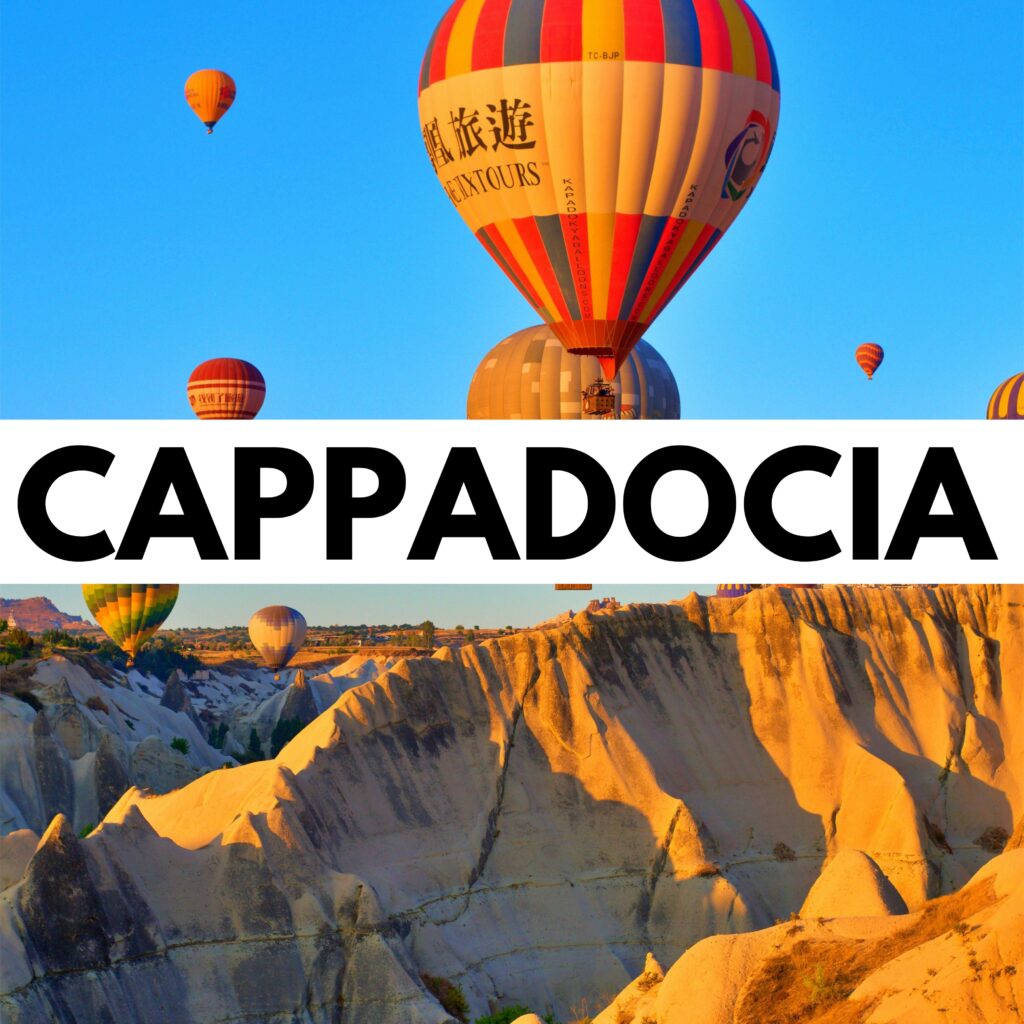
Before going to Cappadocia, Turkiye, all I knew about it was that it was a destination for hot-air ballooning over amazing rock formations. But I found out it is so much more than that. After my summer trip to Cappadocia, I have to recommend it for every bucket list. I was completely awestruck by my visit there. Ancient ruins, history, a castle, cave dwellings, hidden rock churches, underground homes, amazing hikes, great food, four wheeling, and of course the hot air ballooning was the icing on the cake.
When to Go
MakeThe high seasons for Cappadocia are April, May and September, October. I went at the end of June and the crowds were way down and the weather was wonderful. Of course warmer than April and May, but not bad. It seems that most visitors come for about a three day stay. Since my husband and I are slow travelers, we spent eight nights and had an amazing time.
Goreme Town
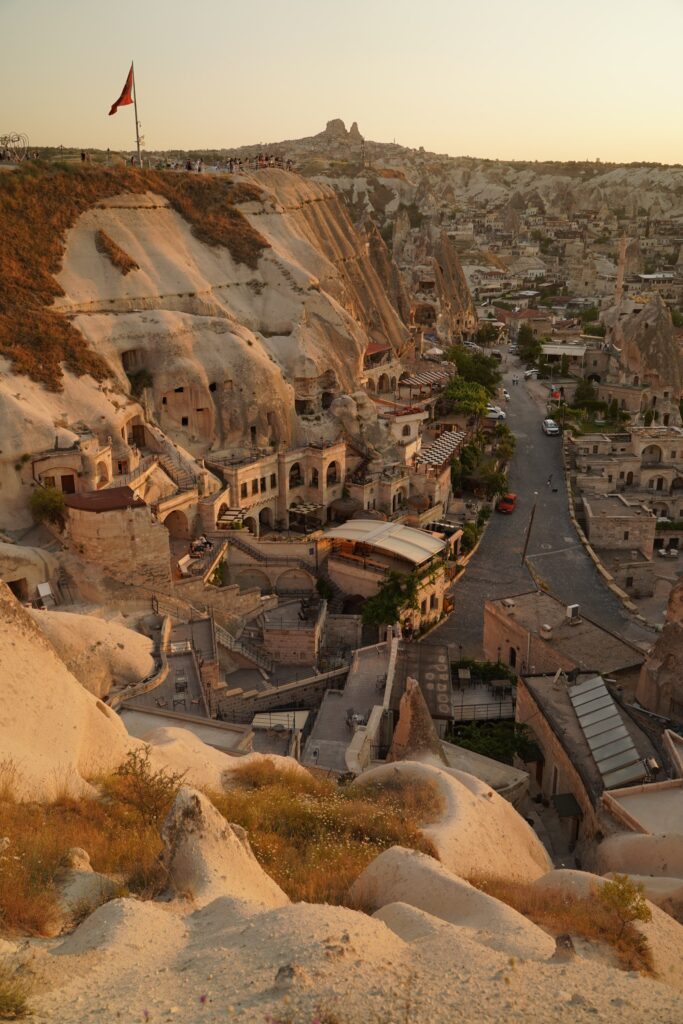
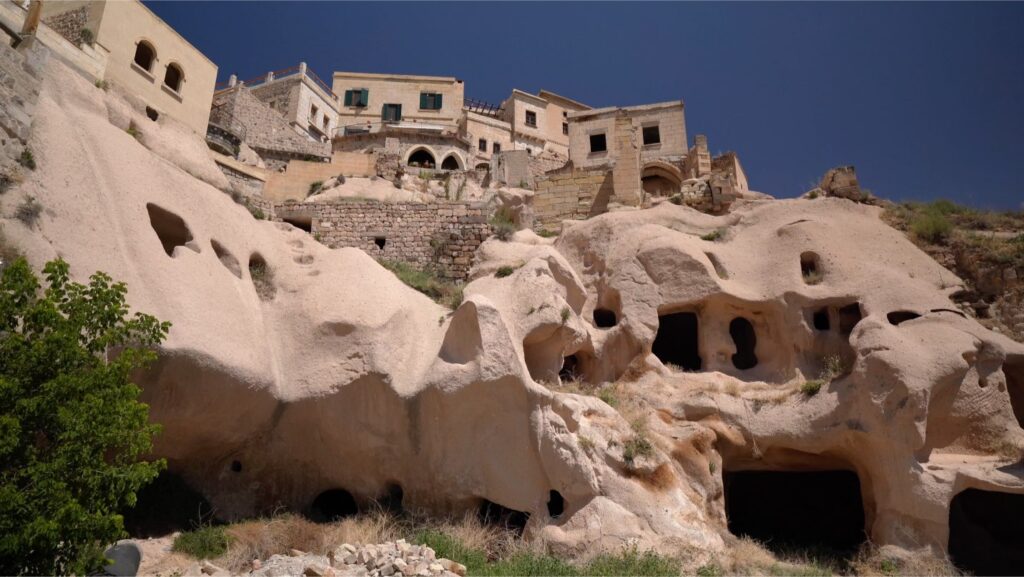
The Cappadocia region is actually two small towns, side by side, Goreme and Uchisar. We spent four nights in each. The first four nights we splurged and stayed in a cave hotel in Goreme. Many of the old homes carved into the rock formations have been turned into boutique hotels and restaurants. From our hotel we were able to walk everywhere very easily. The last four nights we stayed in a hotel in Uchisar.
Cappadocia
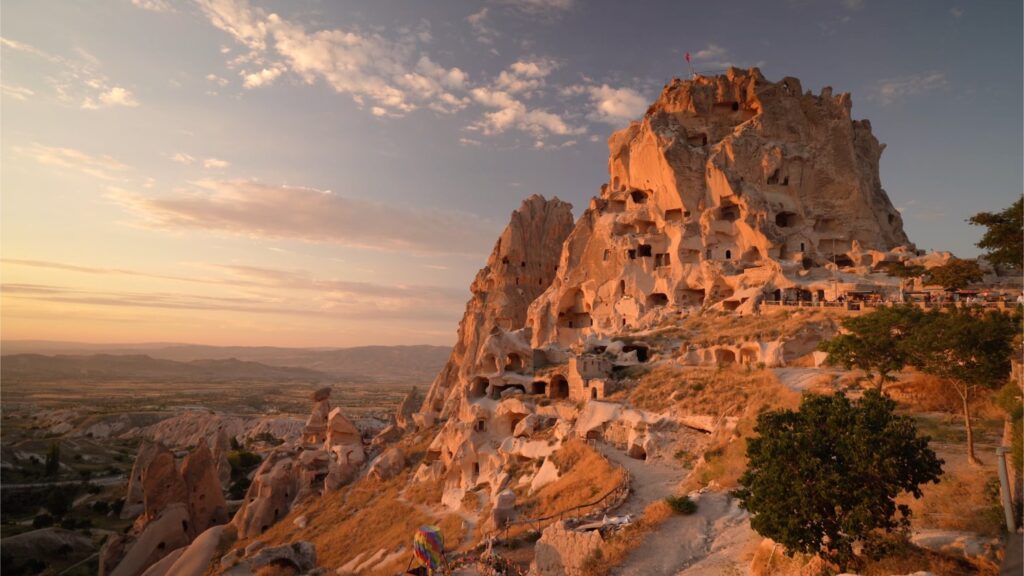
This small village huddles around Ushisar Castle and has been occupied since the 7th century. Even though it is in such close proximity to Goreme, it felt much smaller and more rural as it is surrounded by orchards. Here, the availability of very affordable and ripe apricots, nectarines, and cherries were a big plus for us. I really loved the feel of this place. It was small, very welcoming, and again, everything was in easy walking distance.
Hot Air Ballooning
Ballooning over Cappadocia
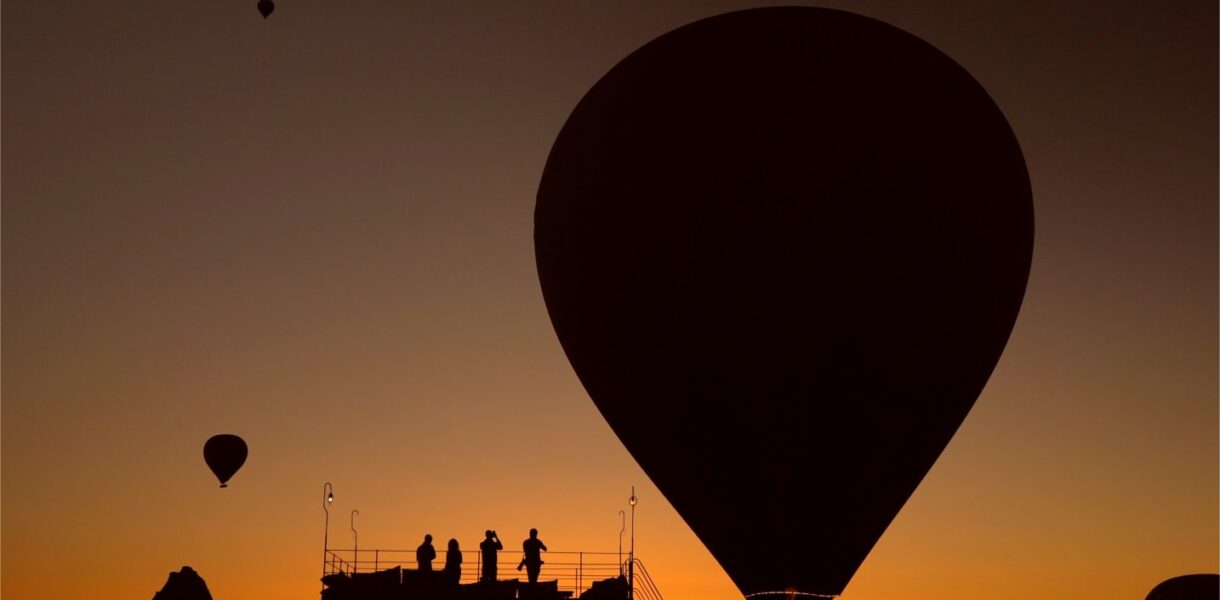
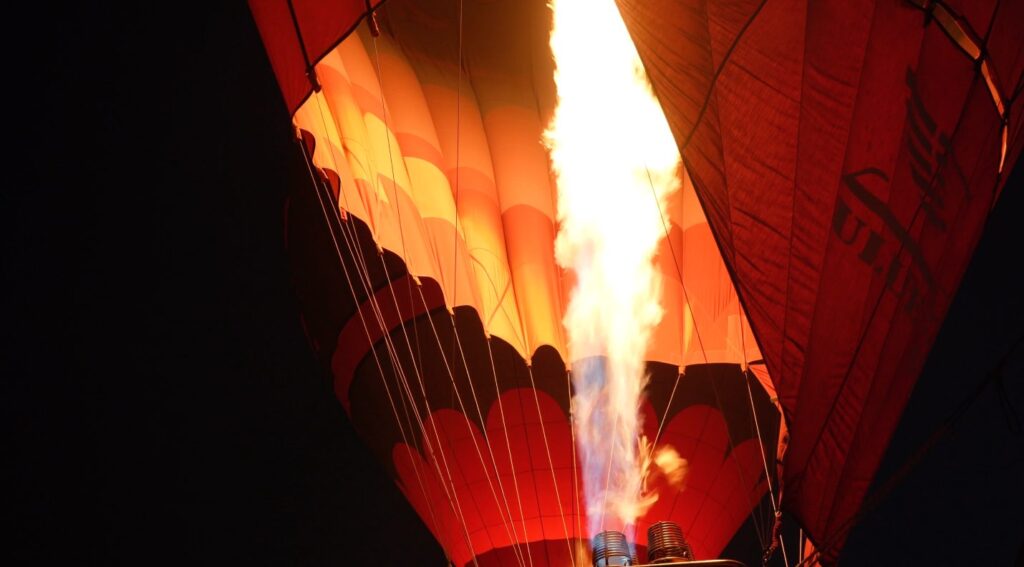
The day we checked into our first hotel, in Goreme, the concierge told us that we should book our hot air ballooning in the next few days as no wind was forecast. They can’t fly if it is very windy. So we booked it for the next morning. A van picked us up at 4:00 am. After picking others up from various hotels, we were taken to the launch site and watched the balloons being aired up in the pre-dawn light.
Hot Air Ballooning
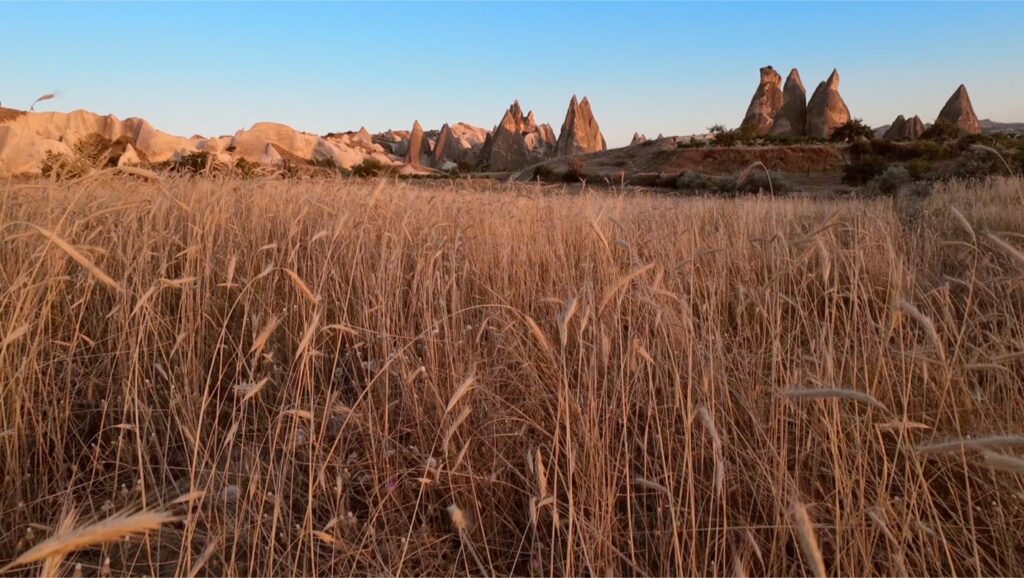
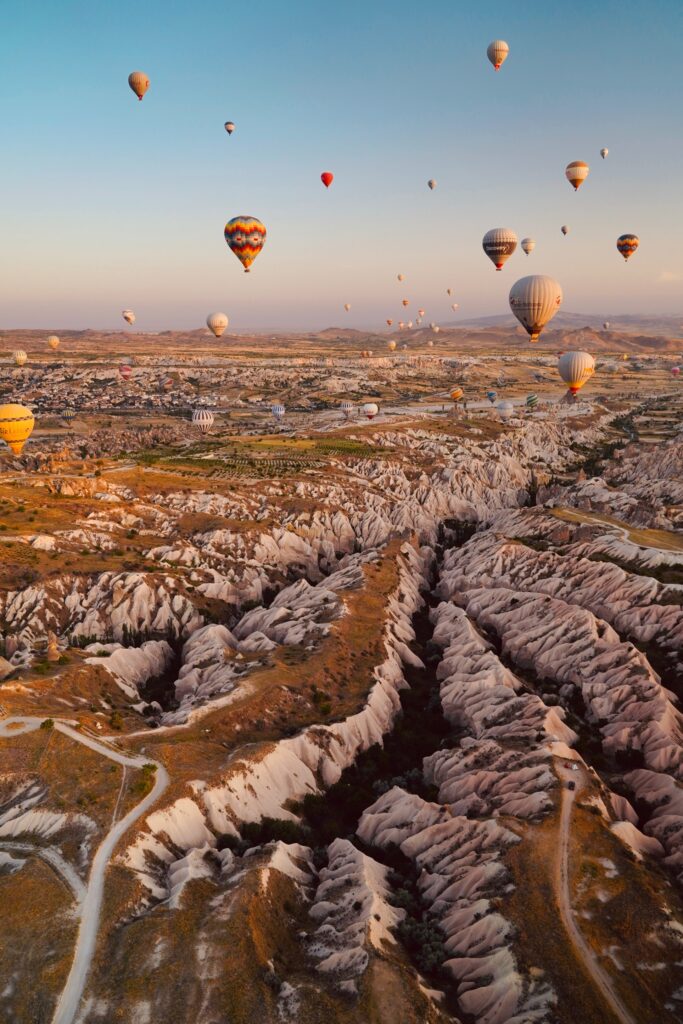
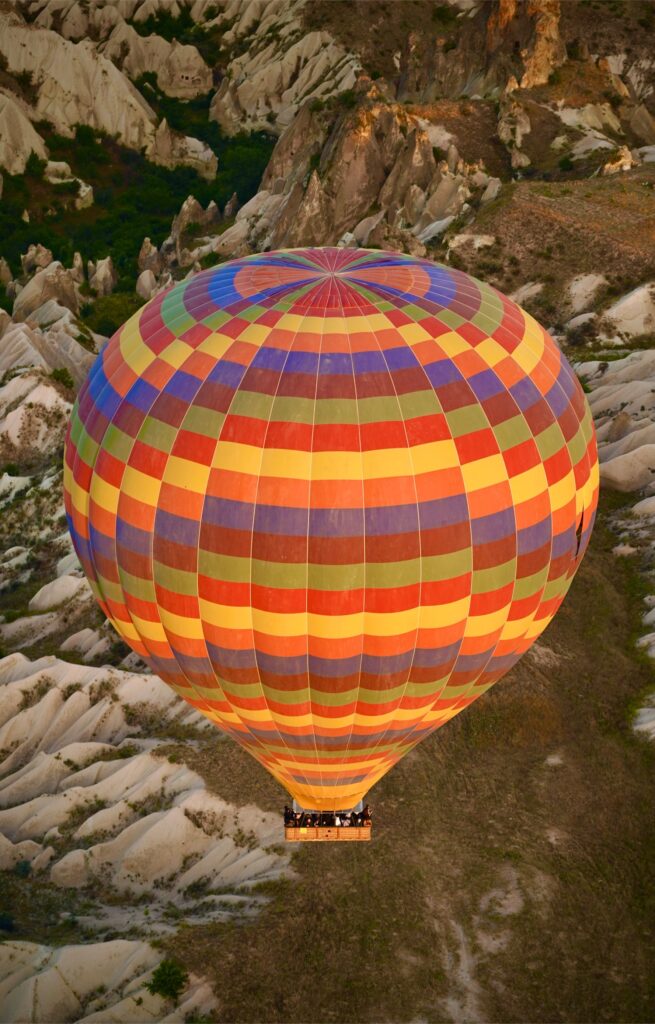
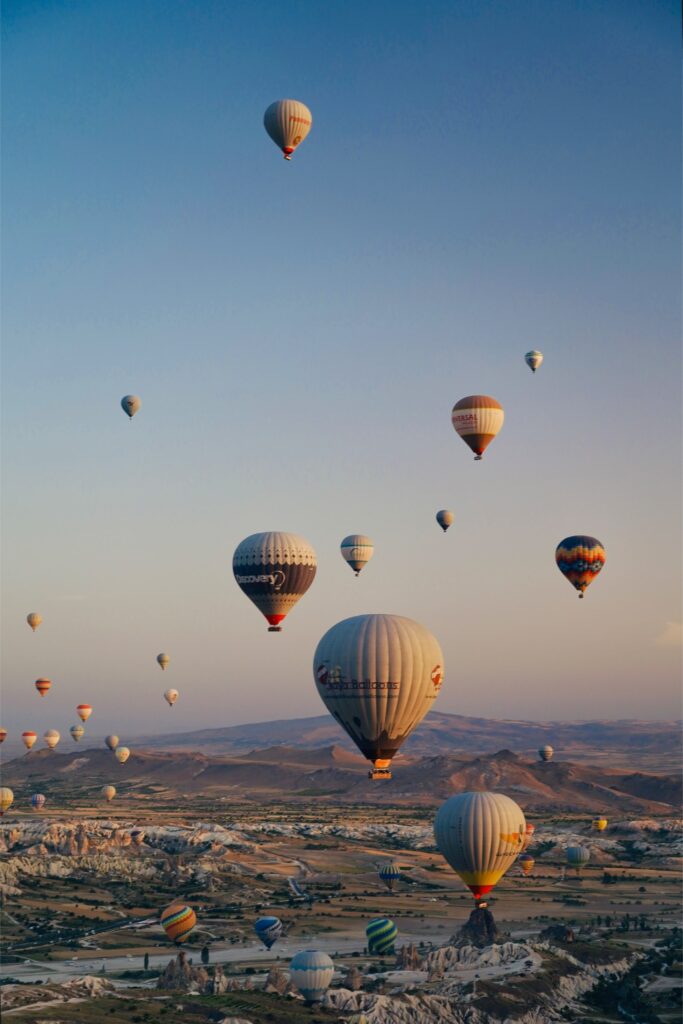
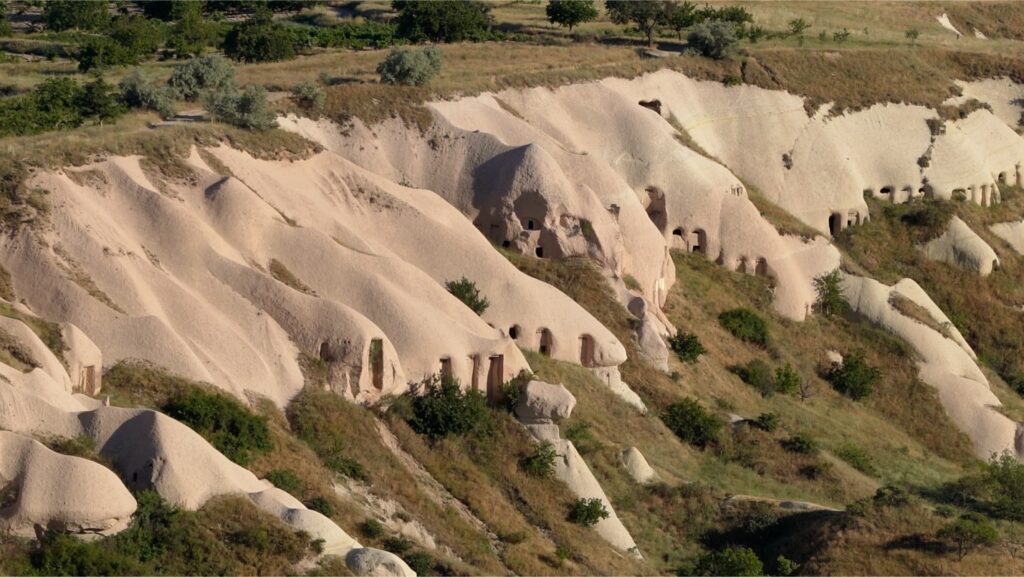
Before we knew it, we were rising into the air to watch the sun come over the horizon. It was magical. Cappadocia is known for it’s amazing and uniquely shaped rock formations called “fairy chimneys”. Sailing over these amazing geological formations and chasms formed over time, by wind and water, was breathtaking.
Ballooning over Cappadocia
Our balloon rose to 2,800 feet (853 meters) and we watched dozens more balloons rising beneath us. Generally, about 165 balloons fly every morning. These balloons are huge. Each basket holds 20 passengers plus the pilot in the middle.
Ballooning over Cappadocia
Our pilot was so interesting too. He was from Cappadocia but had spent the previous three years flying hot air balloons across the Serengeti in Africa. After landing, our ground crew had a table set up with finger foods and glasses of sparkling wine for everyone. It truly was a magical experience.
Goreme Open Air Museum
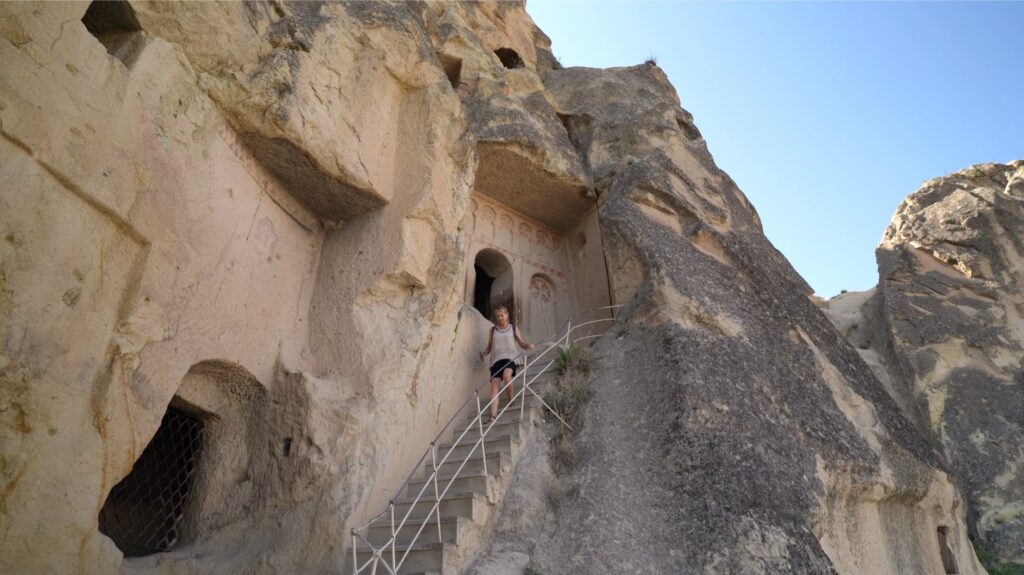
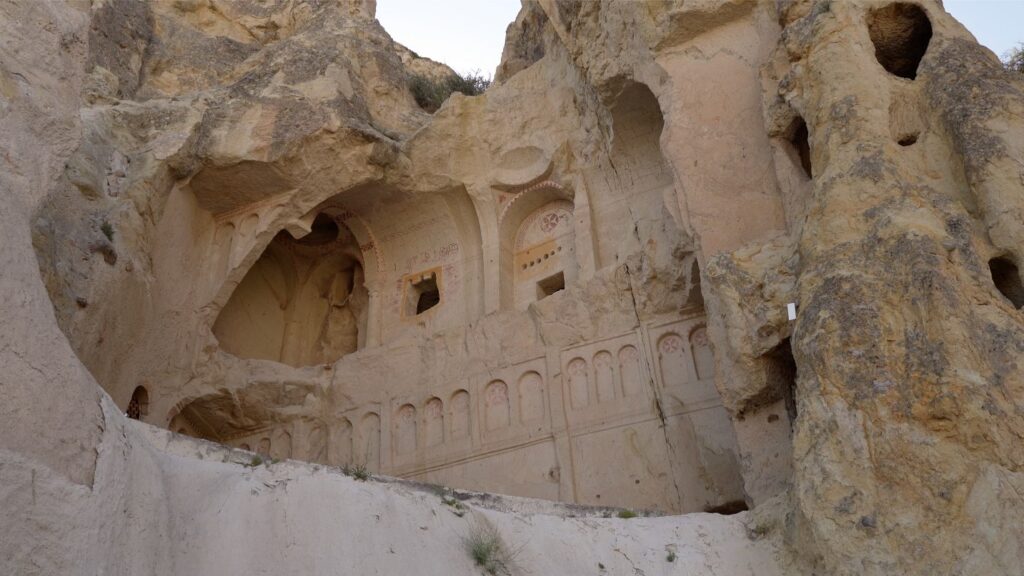
There are several open air museums in the area, but this one is an easy walk from town. A UNESCO World Heritage site, this area contains eleven of the best preserved rock-cut churches from the ninth, tenth, and eleventh centuries.
Goreme Open Air Museum
I was really astounded. Situated high on the rock face, there are stairways leading to their openings now, but they were originally hard to get into. They were built when Christians were still persecuted and had to meet in secret. They all contain amazing frescoes painted on their walls and ceilings. A couple of them were remarkably well preserved with the colors of the paint still bold and bright. They were beautiful.
Goreme Open Air Museum
There is one in particular, called “The Dark Church” that is just unbelievable. It costs an extra 6 Euros to go into, and they limit the number of people a day that can go in. This is for preservation purposes. But it is definitely worth a little extra, I was awestruck. The feeling I had wondering through this ancient site and inside these caves was otherworldly. It was an amazing experience set inside a true piece of ancient history. It pays to get here early and the entry fee is 20 Euros. No photos allowed in this one.
Turkish Breakfast
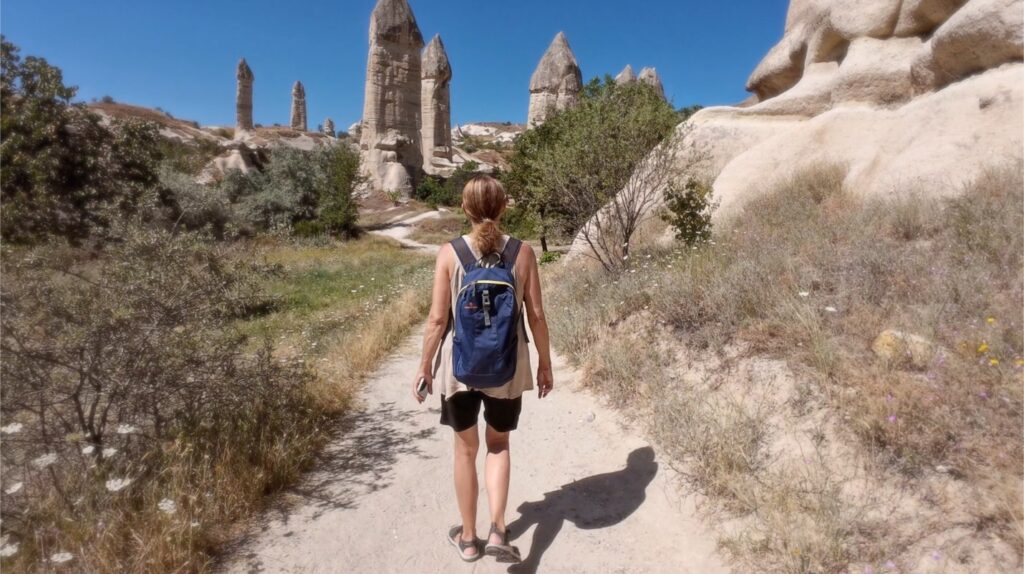
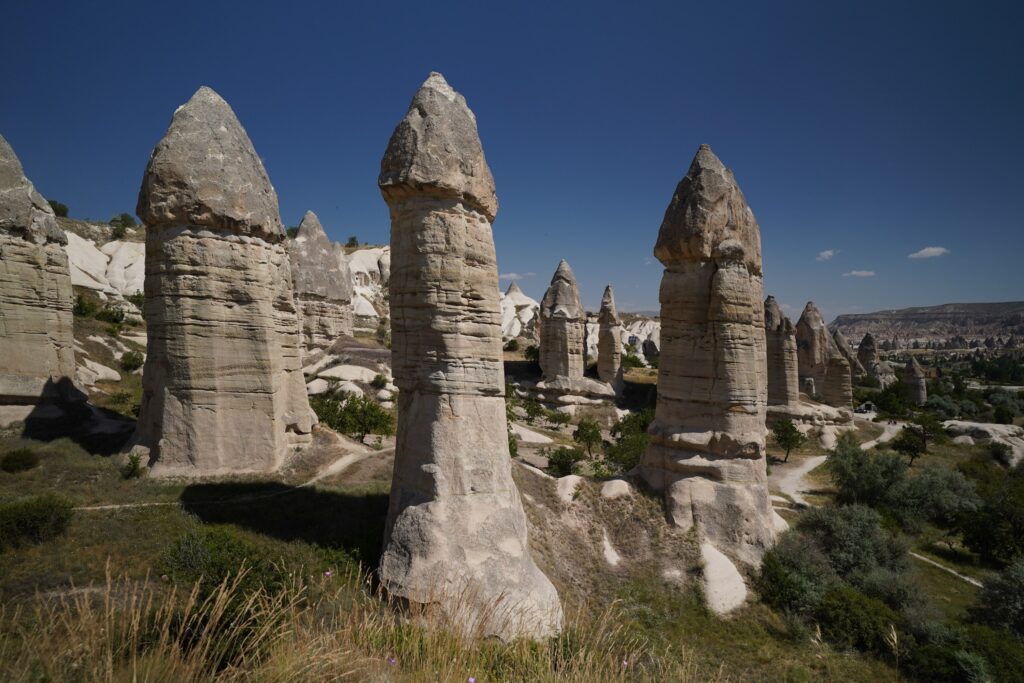
After leaving the museum, we decided to a hike trail that we had seen on our way to the museum. We wandered a path back among hoodoos and fairy chimneys and to take some pictures.
Hiking near Goreme
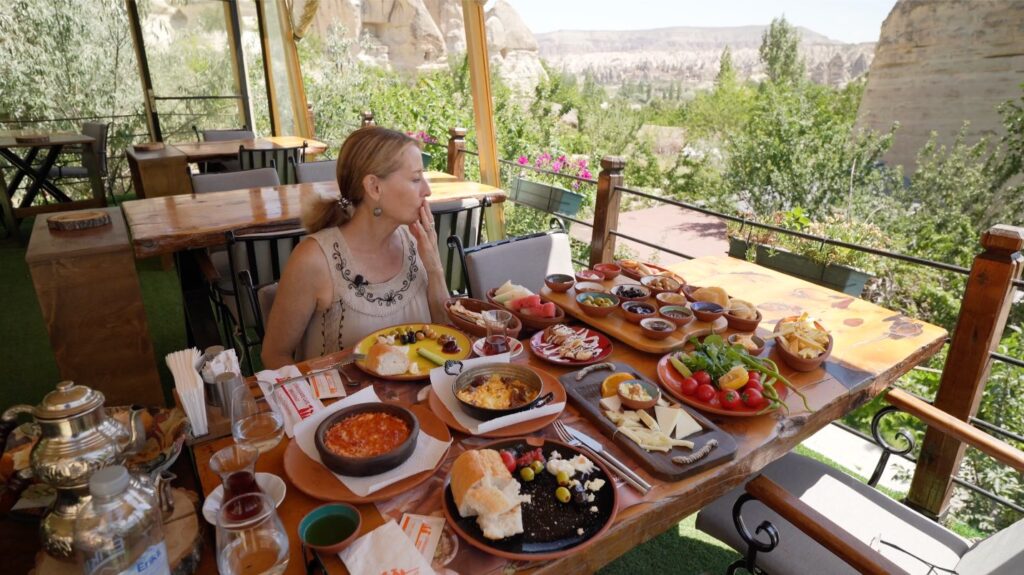
When hiking out of the area, we came upon a lovely restaurant, Goerkundere Cafe, tucked back into the boulders. Their sign advertised breakfast, so in we went. It turned out that they were famous for their Turkish breakfasts and I can see why.
Some Serious Rocks Out Here!
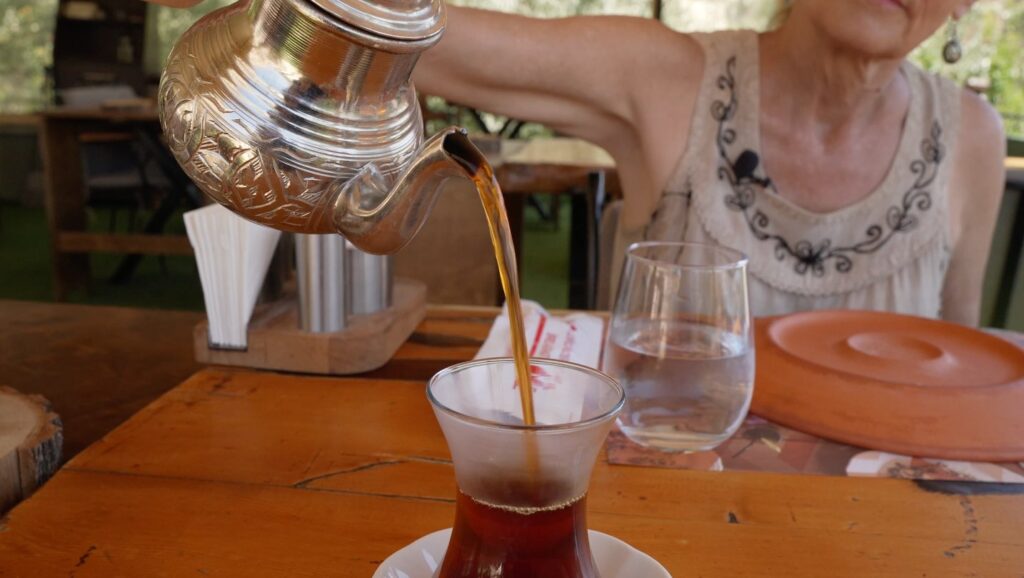
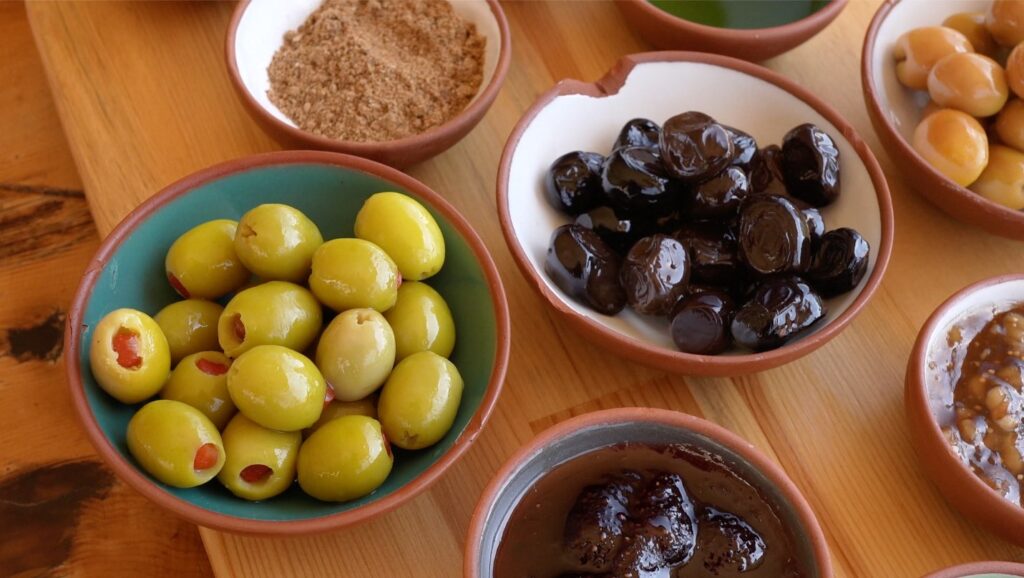
I have never had a breakfast spread like this one, and they just keep bringing food until you tell them to stop. Fresh fruits, fresh veggies, two types of eggs and sausage, cheese platter, meat platter, pastry platter, pancakes, home fries, syrups, jams, honey with clotted cream, yogurt, juices, Turkish tea, and more. I could not believe how wonderful everything was.
What an unexpected treat especially after the amazing open air museum and our hike. I almost needed to be rolled out of here. It’s a good thing we had a little way to walk to get back to our room, this helped all the food settled. The food in Turkey is amazing and we regularly ate way to much!
Uchisar Castle
Uchisar Kalesi
Uchisar Kalesi or Castle is crisscrossed by numerous underground passageways and rooms which served as residential homes in Byzantine times. Although it is no longer inhabited today, it once housed around 1,000 people. Several of the royal rooms inside display unique antique furnishings. It offers great views from the top and it feels magical to walk through the rooms of a castle literally carved from a giant rock formation.
View from Uchisar Kalesi
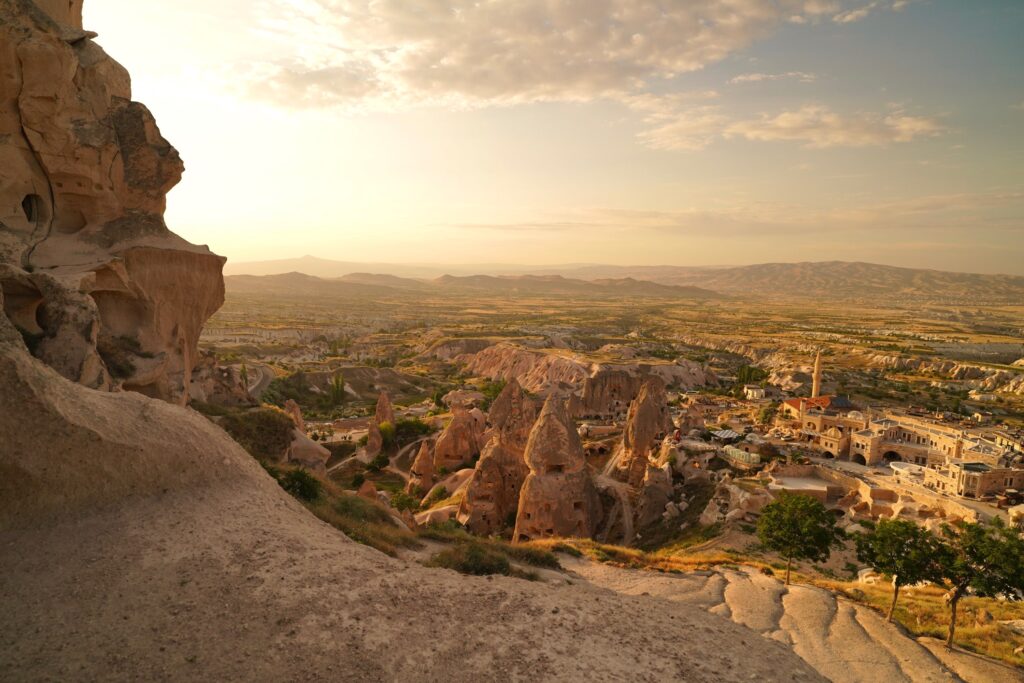
It is a little work to get to the top, but once you’re up there you can see why this place was such an excellent location for a castle. One apartment in particular really struck me as you could see where the cooking fire had been in the kitchen and the stunning view the cook would have had. Some rooms were apartments, some were work shops, and some were for schools. The area around the castle comes alive in the late afternoon and evenings with fruit, food, and souvenir vendors. The small streets leading away from the castle are filled with an array of restaurants and boutique hotels.
Hiking
Pigeon Valley Trail
There are a number of hikes you can do all around this area. None of them to taxing unless you go in the middle of the afternoon when the suns at its peak.
Uchisar
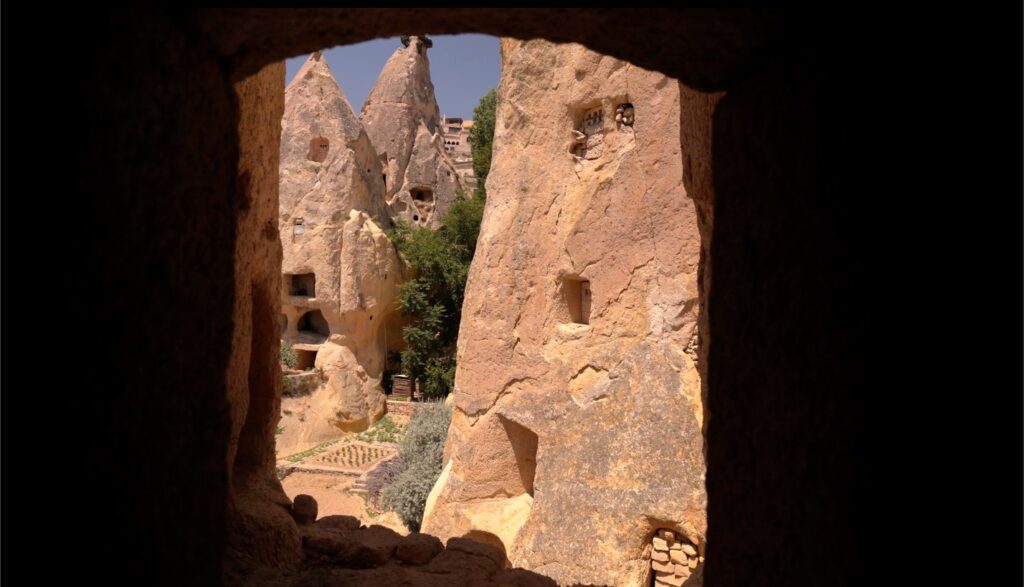
We walked to the edge of Uchisar village and hiked down into the river valley, this is where they grow many crops and orchards. The cliff faces along both sides of the valley are dotted with ancient carved out caves. Some were homes and some were pigeon houses.
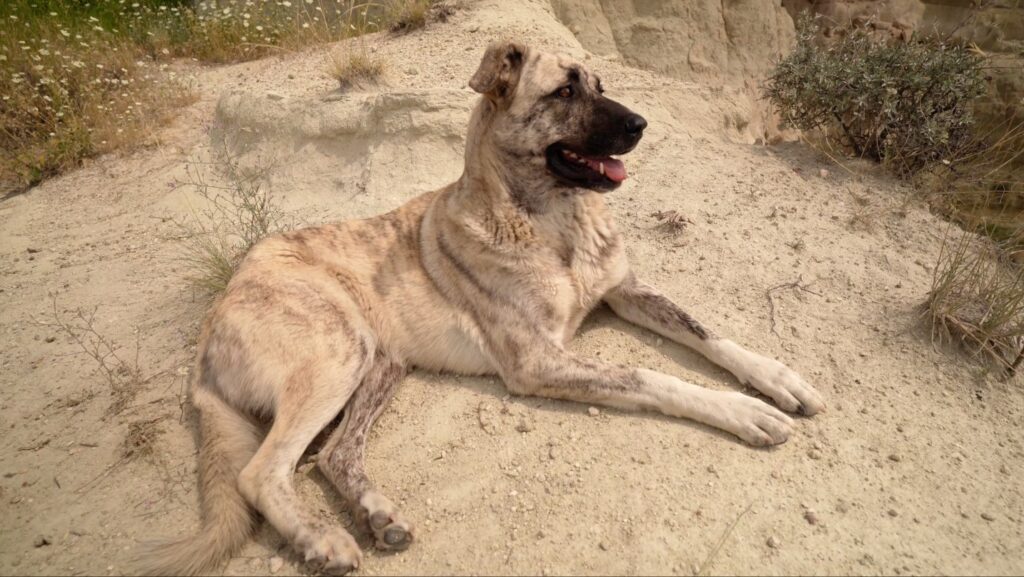
Anatolian Shepherd
They used pigeon guano for centuries to fertilize their crops. A large female Anatolian Shepard joined us for our hike and she was the sweetest girl. She came out of her front yard when we were walking past her house and stuck with us for the whole hike. When we came up out of the canyon, she went on her merry way.
St. Basil Cave Church
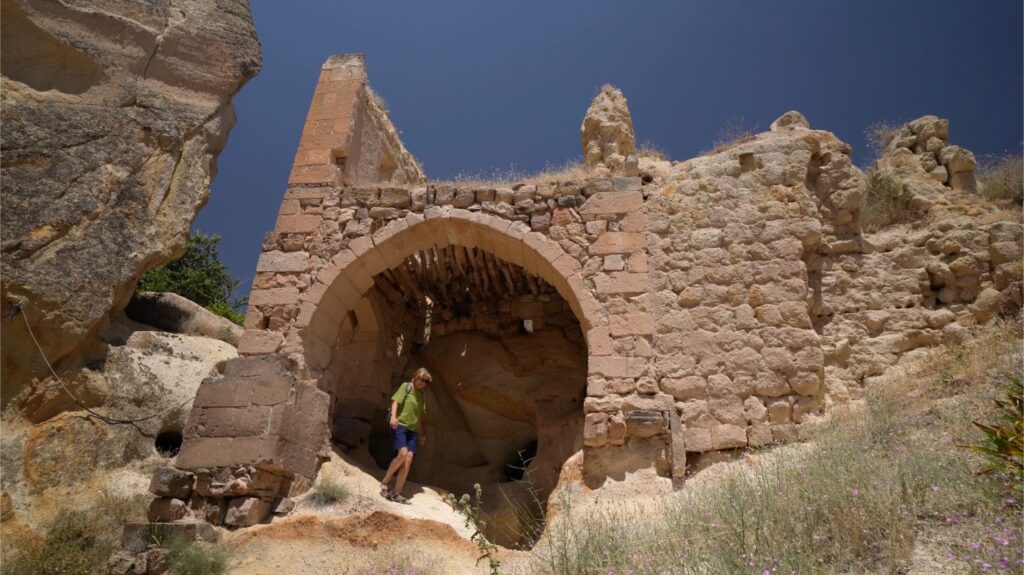
We also did another short hike to find an ancient church. Aaron had read about this ancient, rock cut church. It is not an official site to visit. There is no entry fee, or upkeep of any kind. This was a side mission we chose to undertake, and it did require some searching, scrambling, and climbing. But once we found it and got inside, it was amazing.
St. Basil Cave Church
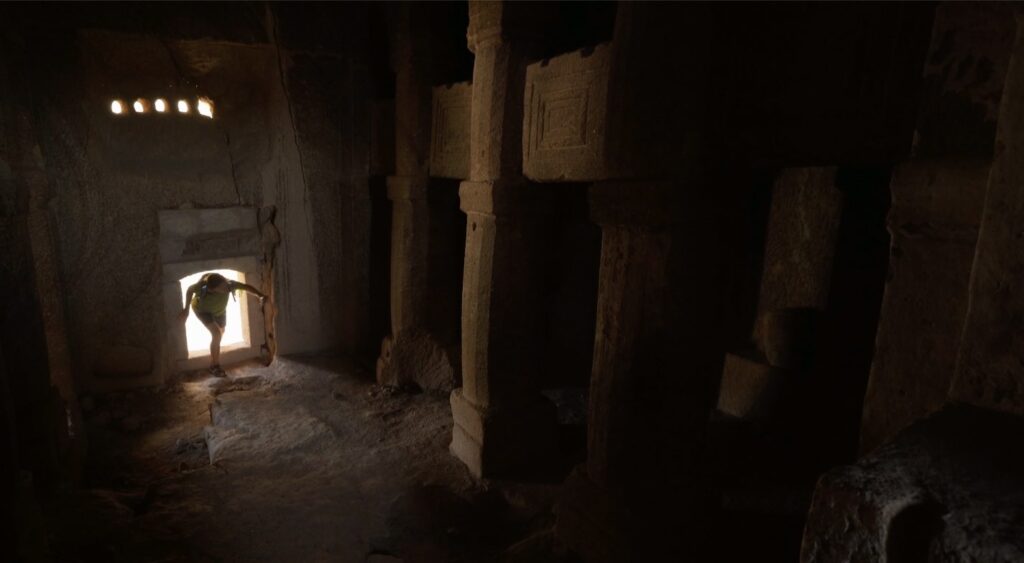
It was huge inside with massive stone pillars that are carved with Syrian art and symbols. It’s origins are a mystery, they only know it was an ancient church and contains many ancient Christian symbols carved into the rock.
Inside St. Basil Cave Church
After the Ottomans took over it was turned into a pigeon house and used for pigeon guano for centuries. It now sits empty and hidden unless you take the time and effort to seek it out. I didn’t feel quite like Indiana Jones, but this place did feel like a hidden treasure that we had found.
St. Basil Cave Church
More Adventure
There is so much to see and do in Cappadocia. For our last adventure here we opted to do a four-wheeler sunset tour. My husband drove the ATV and I held the camera. We followed our tour leader out among the amazing rock formations to another hidden church, then walked up a hill to watch the sunset. It was an easy and fun side adventure that allowed us to see another part of the surrounding area. You also have the option to do this on horseback.
Uchisar Town
As budget travelers we have to be a little picky about what see and do, and how much it costs. But we were able to fit in a lot of history, fun, and adventure here. We also had some great food to boot. Cappadocia was a magical place and turned out to be so much more than we were expecting. I am so glad we spent a full eight nights here as this allowed us to really see and do so much more than the hot-air ballooning. It is definitely a bucket list destination.
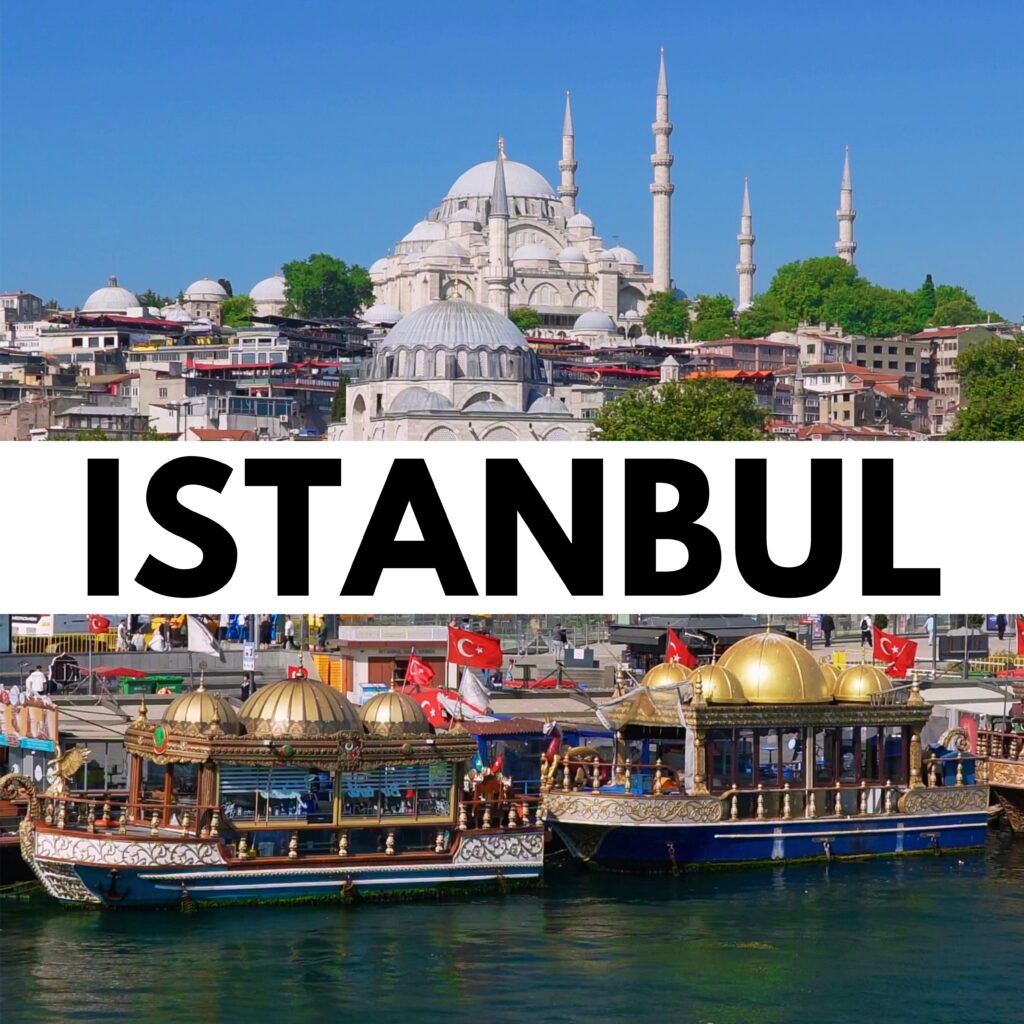
If you are debating about where you should go for your next vacation, or for that once-in-a-lifetime travel experience, let me introduce you to Istanbul, Türkiye (formerly Turkey) and you can see for yourself if this exotic destination is for you. Once home to Sultans and Emperors, Istanbul is one of the great historic cities of the world. Food, culture, history, adventure, shopping, Istanbul has it all!
Getting to Know Istanbul
Istanbul was the most visited city in the world in 2023, followed by London, and then Dubai. We spent a whole month here. You can easily see most of the famous sights in a week, but like I said, we are slow travelers. We love spending longer in a location and getting to know the people, the culture, finding the best local places to eat, and visiting some off the beaten path places. Istanbul is also known for being a shopping and medical/dental tourism destination. But the history here is what captured me.
Galata Neighborhood
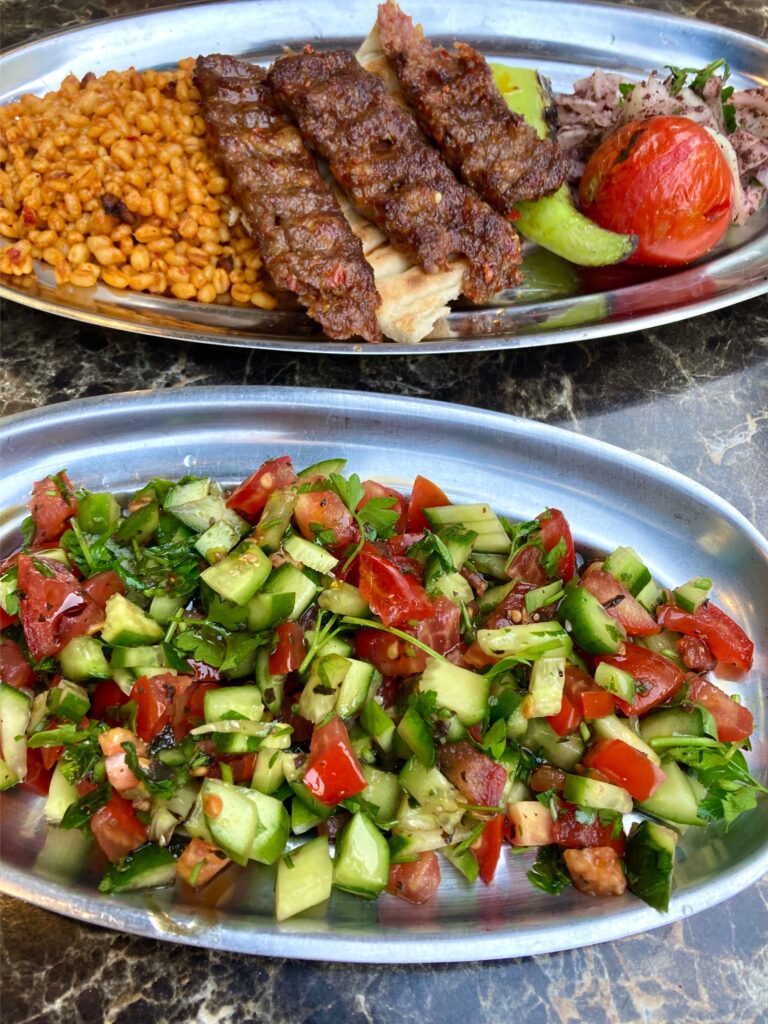
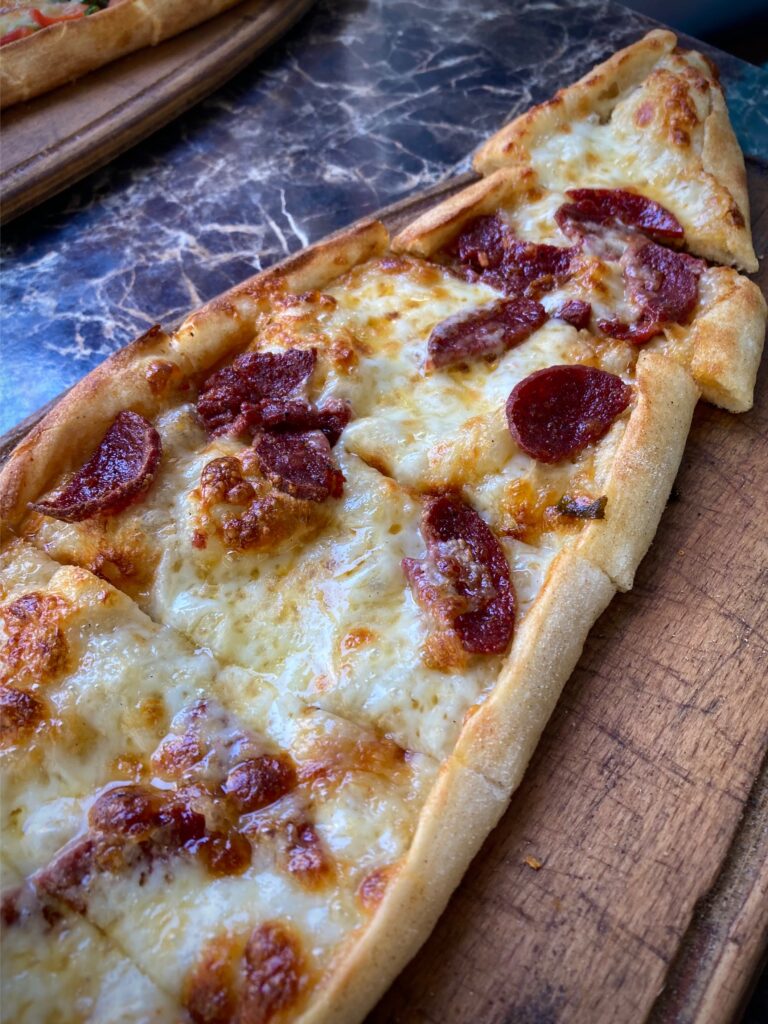
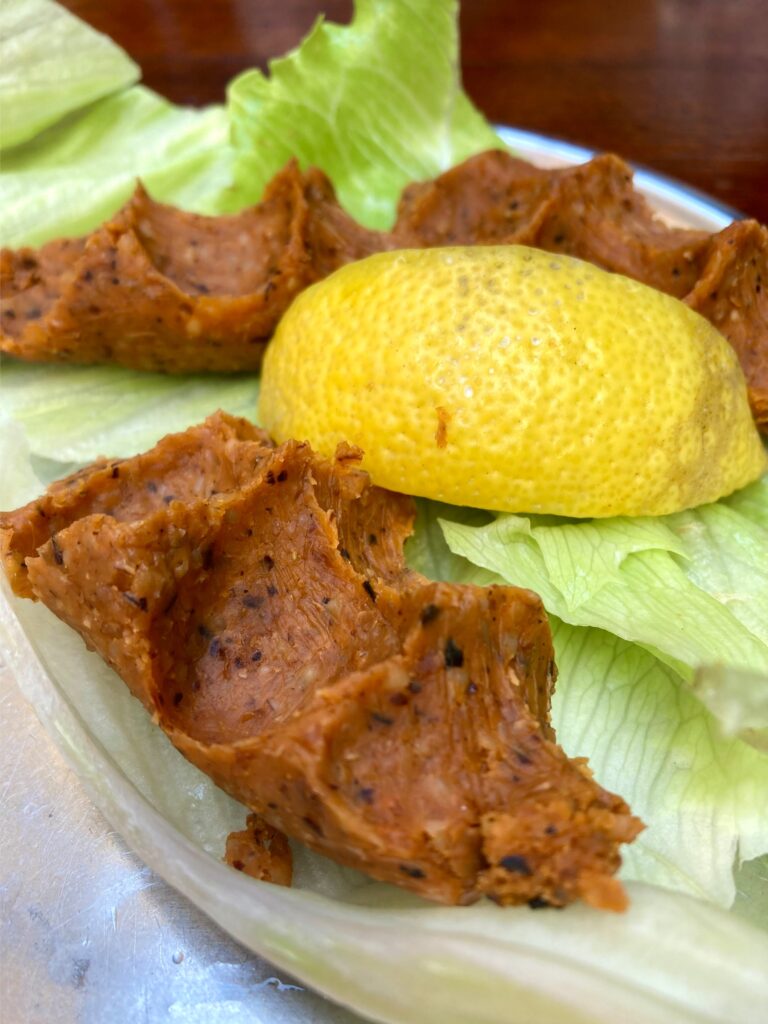
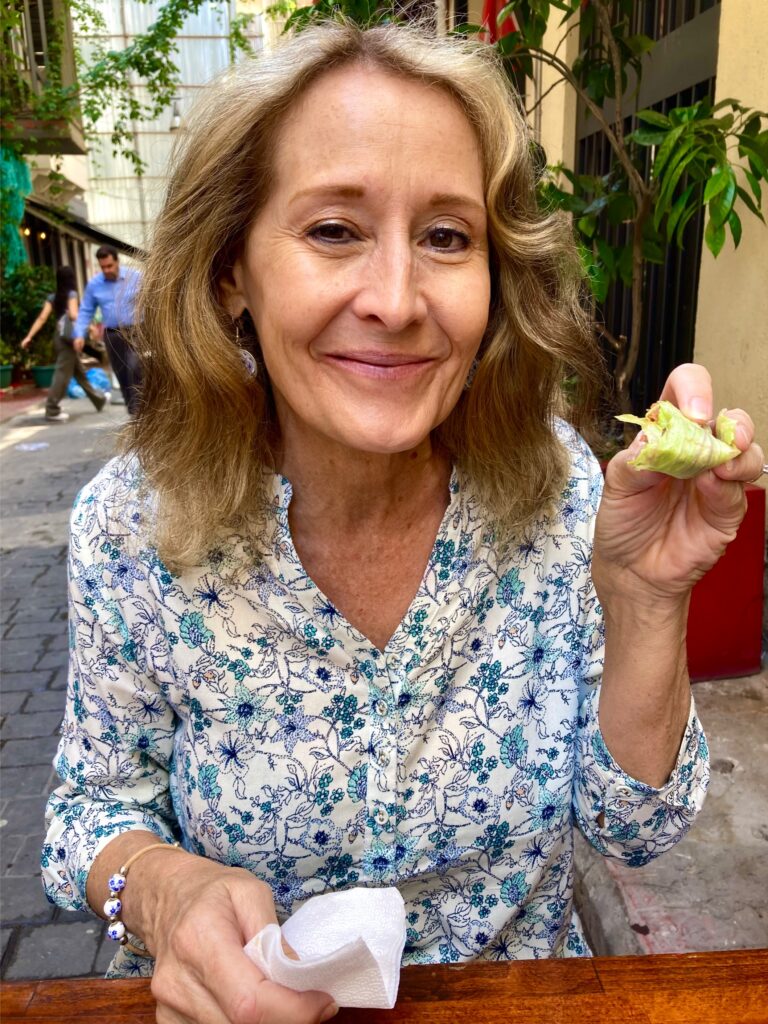
We always try to stay in a local neighborhood, if possible, and we had a nice room at a boutique hotel that was in a great neighborhood called Karakoy. We were very happy to find that our street had a small local breakfast place where we discovered the wonderful Turkish coffee. Plus a great little grocery store and a few tasty local restaurants, all very reasonably priced. We became regulars in all these places. After our first few visits to these establishments, we felt like part of the neighborhood as we were greeted warmly and exchanged small talk with the proprietors. Just on our street we enjoyed tasty lamb Adana Kebap, and Pide (pee-day) or Turkish pizza. I also discovered Çig Kofte. A vegetarian dish consisting of a paté made from bulgar wheat, herbs, and spices. It is formed into patties and put into a lavash wrap along with fresh veggies and sauce. I was hooked on this dish!
Adana BebapPideÇig KofteÇig Kofte
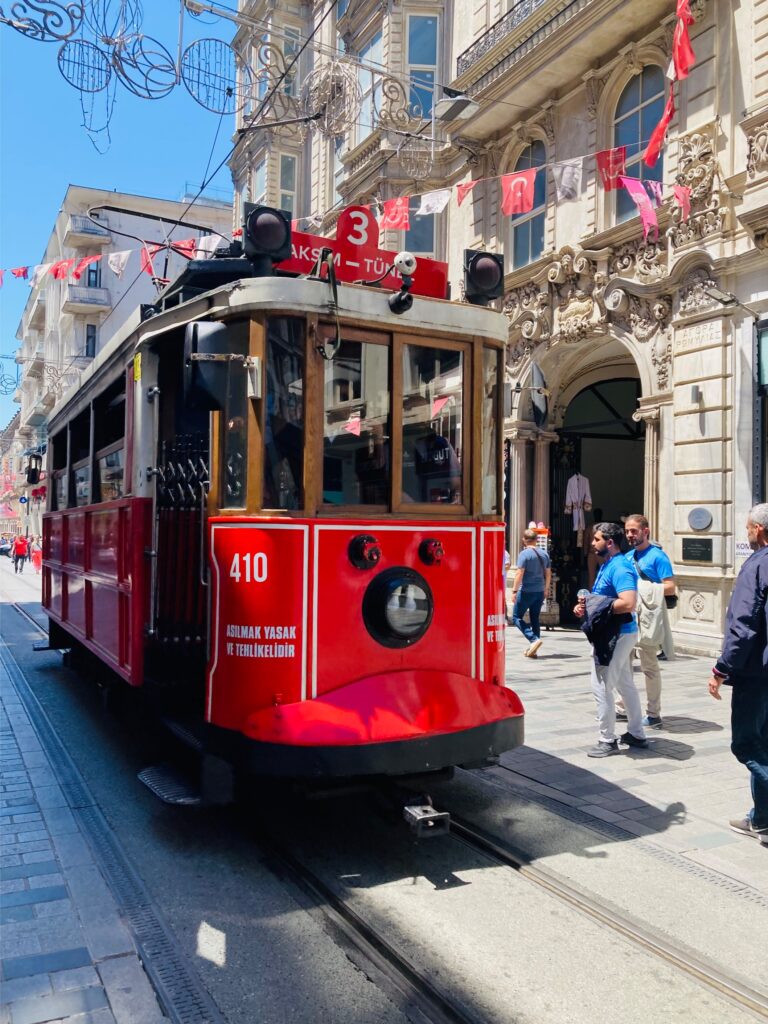
Our neighborhood was also very close to a tram station, and in walking distance to quite a few historical sites. One of the first things I noticed after we arrived, were pet sized food and water dishes outside of almost every business and residence in the city. This is because Istanbul is a city of cats. So if you’re a cat person, you’ll love it.
For a big city, Istanbul is very easy to get around. There are taxis everywhere, but that can add up pretty quickly. One of the first things we did was to buy ourselves Istanbul cards. This card gets you on the metro tram, public buses, ferry boats, and even into public toilets. You can get the card from a machine anywhere there is a metro station or a ferry terminal. You load some money onto it and it’s ready to swipe whenever you want to get on any form of public transportation, and you can top it up as needed. We used our cards to get around the city and to take ferries cross the Bosphorus to the Asian side of Istanbul and it really saved us a lot of money. The trams and ferries are all modern, clean, and air-conditioned. Since this is a big tourist destination, English is widely spoken and used in signage at all public transportation stops, ATMs, and most everywhere else. It also seemed that there was a friendly person that asked us if we needed help when we seemed confused by something. The people here are part of this city’s charm.
Old TramNew Tram
I have to set the scene with a little bit of historical background to show how dynamic this city really is. Sitting at the crossroads where Europe meets Asia, Istanbul is an ancient city, and I was overwhelmed by the amount of history here. Founded in 657 BC, and known as Byzantium, over the centuries it was ruled by the Greeks, Persians, Spartans, Athenians, and Macedonians before becoming part of the Roman Empire. In 324 BC the city was conquered by Constantine the Great, and it became Constantinople. The seat of the Roman Empire was moved from Rome to Constantinople, and Christianity was adopted, legalized, and made the state religion by the Emperor Constantine. I mention this because there is a lot of religious history here.
Golden Horn
In 1453, the city was conquered by the Ottoman Empire and the official religion became Islam. Then in 1923, after the Turkish War for Independence, the Republic of Turkey was established under Mustafa Ataturk. As the country’s first president, Ataturk modernized Türkiye’s culture and led the nation into becoming a modern European country. The city officially became known as Istanbul in 1930.
The Hippodrome
The first place we visited was the Sultan Ahmet Square, where three must visit sites are in close walking distance to each other. The Hippodrome, the Hagia Sophia, and the Blue Mosque. The enormous Sultanahmet Square itself is where the Hippodrome stood for over 1,000 years. Built in 203 AD, this was an arena used for chariot racing. Talk about fascinating! In 324 AD the Emperor Constantine had it enlarged to hold 100,000 spectators. This was the center of the city’s social life, and huge amounts of money were wagered here. There were 4 racing teams, each consisting of 2 chariots pulled by 4 horses, and each team was sponsored by a political party.
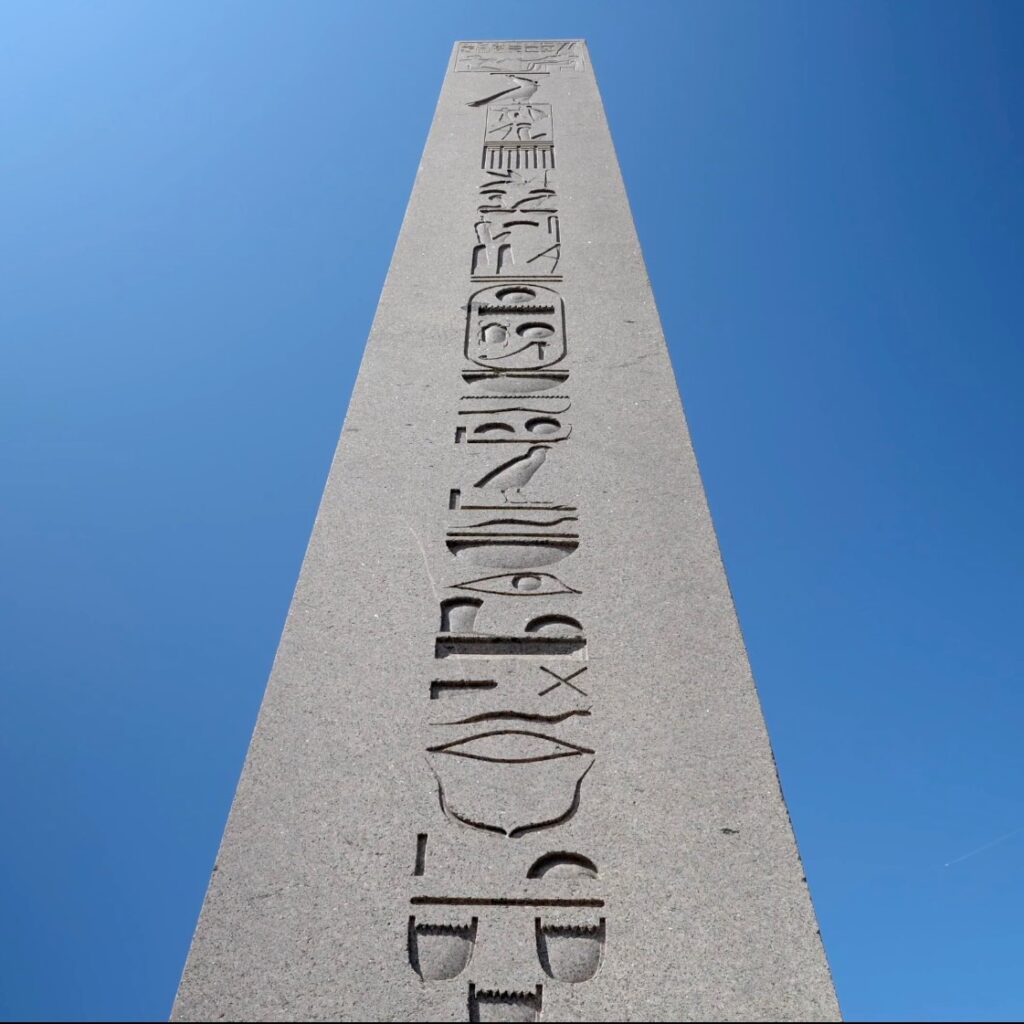
Obelisk of Emperor Theodosius
Once adorned with great works of art and even bronze statues of famous chariot drivers and their horses, none of that remains today. But you can still see the remains of Emperor Constantine’s Serpent Column, and the obelisk of Emperor Theodosius the Great, which he brought all the way from Luxor, Egypt. Standing in the middle of this huge space, I found it exciting to imagine the chariot races and everything else that went on here for centuries.
The Hagia Sofia
At one end of the Hippodrome stands the Hagia Sofia, which translates to Holy Wisdom. If I had the opportunity to visit only one thing in Istanbul, I would pick this. Built in 532 AD, under Emperor Justinian I, the Hagia Sofia is a representation of outstanding Byzantine architecture and art, and a major cultural and historical site here in Istanbul. The first of it’s kind, it’s dome alone is said to have changed the history of architecture. Built by the Eastern Roman Empire, this was the principal church of the Byzantine Empire in the capital of Constantinople, now known as Istanbul.
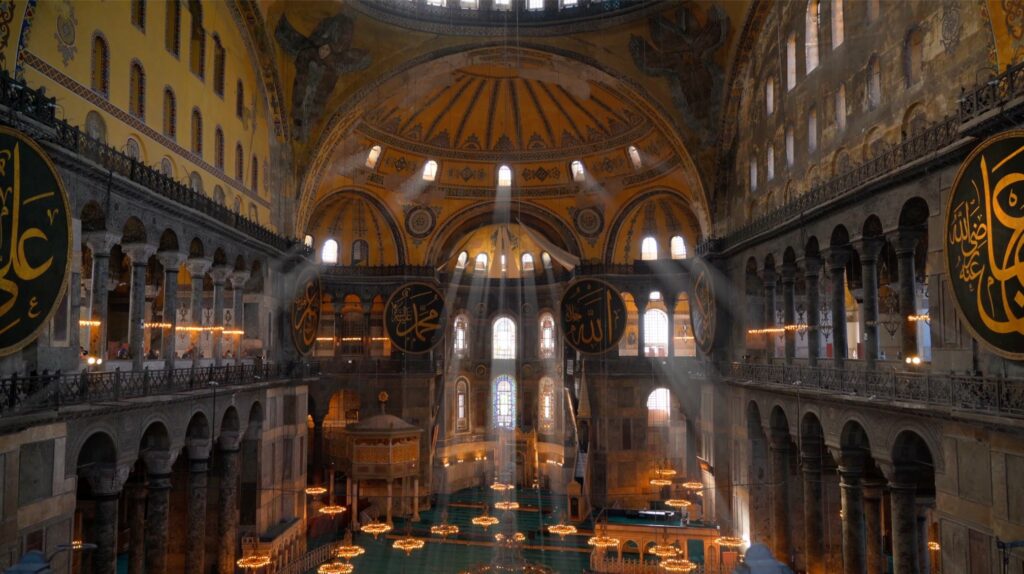
Hagia Sophia
It is described as “holding a unique place in Christian history” because for almost 1,000 years this was the world’s largest cathedral, and the center of religion for the Eastern Orthodox Church. In 1453 the city was conquered by the Ottoman Empire and it was converted to a Mosque and remains so today. I was blown away by the beauty of not only the building itself, but also the amazing mosaic art decorating the walls, that reflect its history of being both a Christian church and a Muslim mosque.
The Hagia Sofia is still an operating mosque today, but everyone is welcome to come in and tour the second level and the grounds, during non-worship hours. Even though the Hagia Sofia, and the entire country, were taken by the conquest of the Ottomans in 1453, and the cathedral turned into a mosque, the beautiful Christian mosaics inside were not destroyed. You can still see this beautiful artwork today that reflects Jesus, the Emperor, the Empress, the Apostle John, and Mary with baby Jesus. Throughout the centuries and the countless battles fought here, these mosaics were never destroyed and stand as timeless witnesses to the cultural and religious history not only of this building, but of the city itself.
Interesting fact, on the marble railing that surrounds the second level, there is a small portion with a protective covering where you can see that someone carved their name into the marble. It says Halvdan. He was a Viking soldier serving in the Emperor’s Royal Guard. I find it funny that someone would be brave, or stupid, enough to carve their name into the Emperor’s new cathedral.
The Blue Mosque
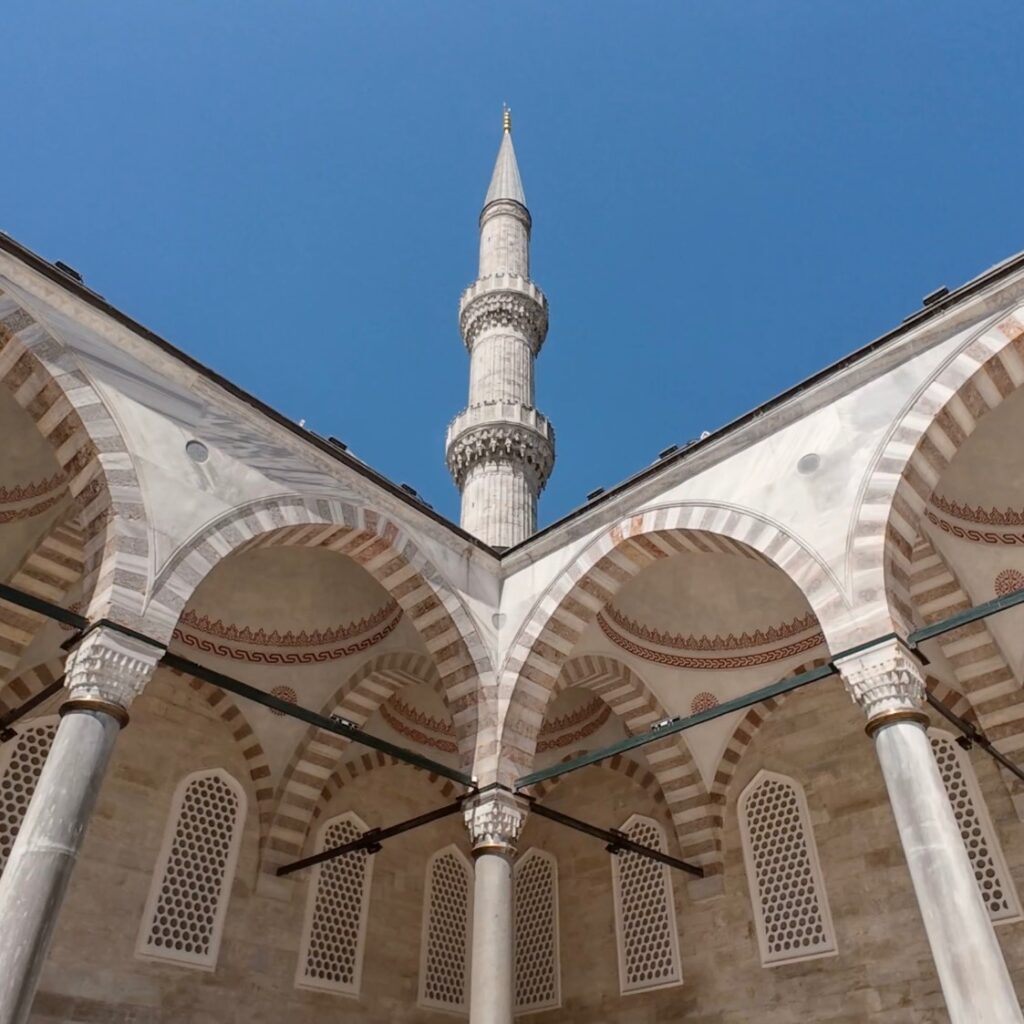
At the opposite end of the Hippodrome you will see the domes of the beautiful Blue Mosque, one of the most iconic and visited places in the city. This popular monument of Ottoman architecture is officially known as the Sultan Ahmet Mosque. This historical imperial monument was built in 1609. It remains a functioning mosque today, and is a UNESCO World Heritage site.
Blue Mosque
Inside it is decorated with thousands of Iznik tiles and hand painted motifs in various shades of blue, giving it it’s popular name. This place was packed with tourists from all over the world, but it is so large inside that it never felt crowded or overwhelming. This site is free to enter, and is truly beautiful to see.
The Spice Bazaar
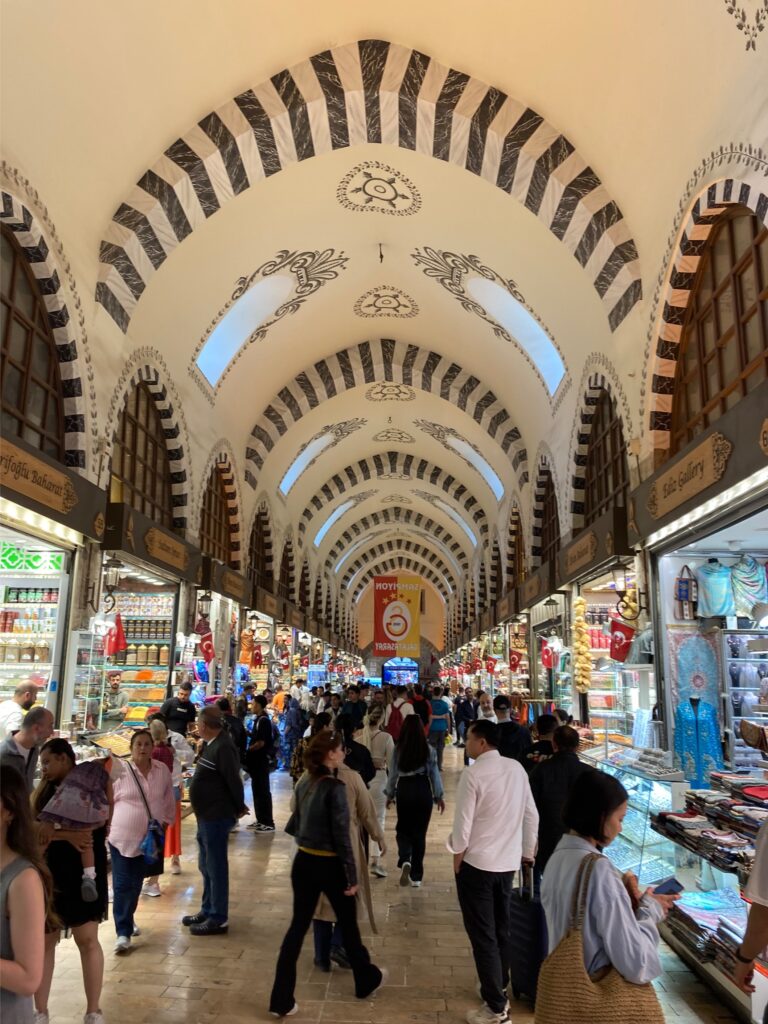
Istanbul has two iconic, and ancient bazaars. The Grand Bazaar and the Spice Bazaar. The Grand Bazaar is Istanbul’s most famous bazaar. But I opted to visit the Spice Bazaar, also known as the Egyptian Bazaar. Built in 1664, the Spice Bazaar wins the prize for being the most colorful, and fragrant ancient bazaar.
Spice Bazaar
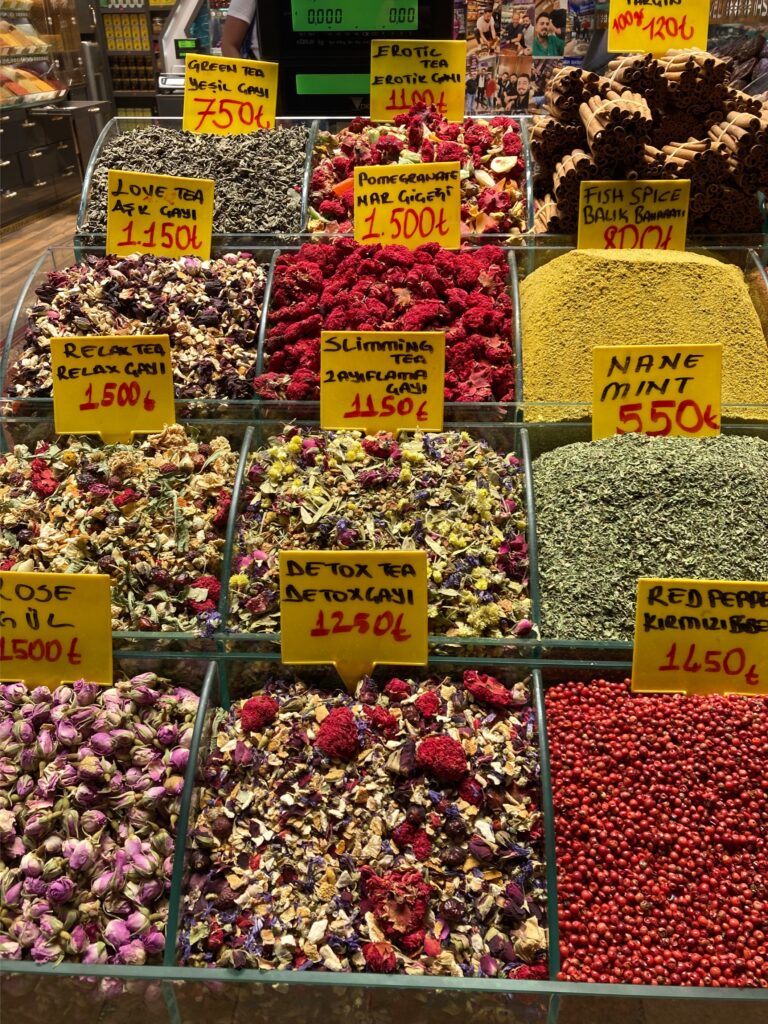
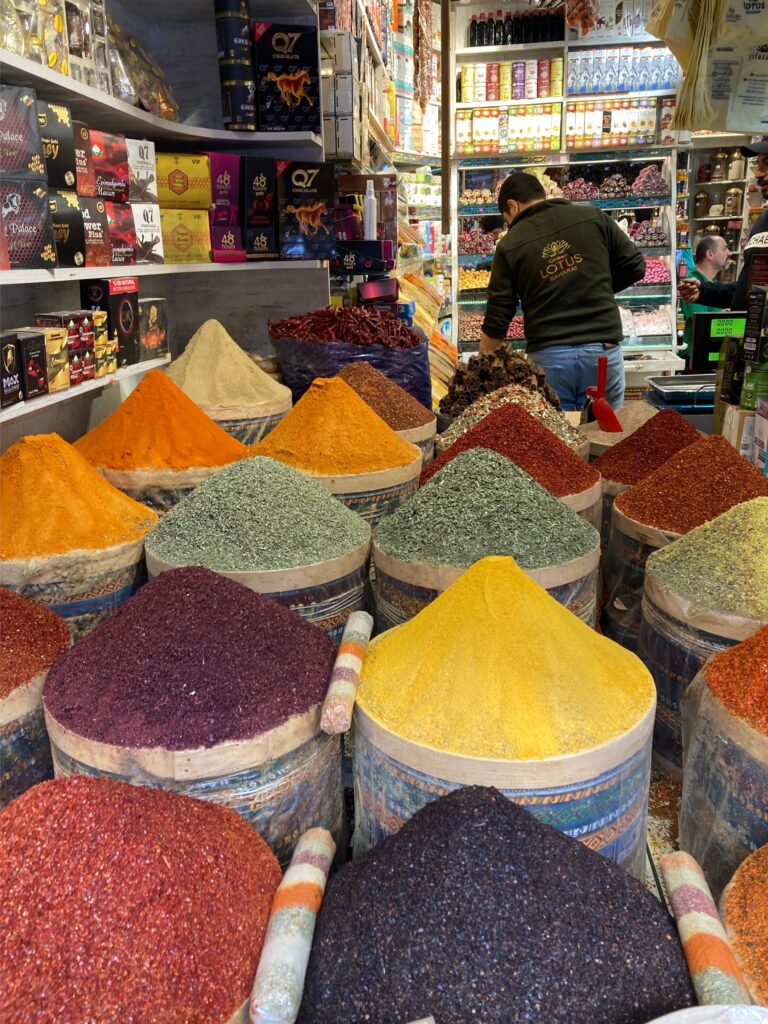
This market offers just about every spice you can think of, and some I had never heard of, all heaped in colorful pyramids. It’s a feast for the eyes as well as the nose. Aside from the spices, you can find every kind of tea you ever dreamed of, along with the famous Turkish Delight candies of every color and flavor. I sampled several of these and had to buy a small bag.
You can also find herbal remedies, perfumes, dried fruits, nuts, baklava, olive oils, cheeses, Turkish coffees, Turkish rugs, incredible brass, silver, and ceramic wares, and my favorite the beautiful Turkish lamps, and so much more! And the vendors do expect you to haggle with them over prices. There was so much to see inside the covered market and it continued on into the streets surrounding the outside. It was great fun and I will definitely be visiting the Grand Bazaar on my next trip to Istanbul.
Galata Bridge
The Galata Bridge spans the Golden Horn which gets its name from its horn shape. This waterway is the primary inlet of the Bosphorus Strait in Istanbul, where the strait meets the Sea of Marmara. The Galata Bridge carries vehicles, pedestrians, and a tram line. This is the fifth version of the bridge to be built here on this site. This romantic looking bridge has been the subject of many paintings, poems, books, and featured in several movies, and it is also known to be an iconic fishing spot. There are two walking levels on the bridge, and in 2003 restaurants started to open on the underside of the bridge. We passed several hot afternoons here enjoying a plate of fried anchovies and a beer. You can sit back and watch the fishermen reel their catch in to the top level, there is also a killer view on both sides of the bridge.
Galata Bridge
On the Eminonu side of the bridge you can find these beautiful boats that sell a famous fish sandwich called Balik Ekmek, meaning fish and bread. These were quite tasty, but I much preferred the fish wrap found on the Karakoy side of the bridge. Small vendors with coolers full of fresh fish and a grill. Lavash flatbread, grilled fish, fresh veggies, and sauces made for a great and affordable meal.
Fun fact, It is even thought that the card game “Bridge” acquired its name because the British soldiers who invented it, crossed the Galata Bridge on their way to their favorite coffee houses. The bridge is nice to walk across and just take in the scenery and watch the fishermen, and a very convenient way to see more of the city.
Basilica Cistern
One of the few things not in walking distance for us was the Basilica Cistern. We took the tram, and it was quick and easy. Arriving early, we were among the first few to enter and enjoyed this massive place with only a handful of other tourists.
Basilica Cistern
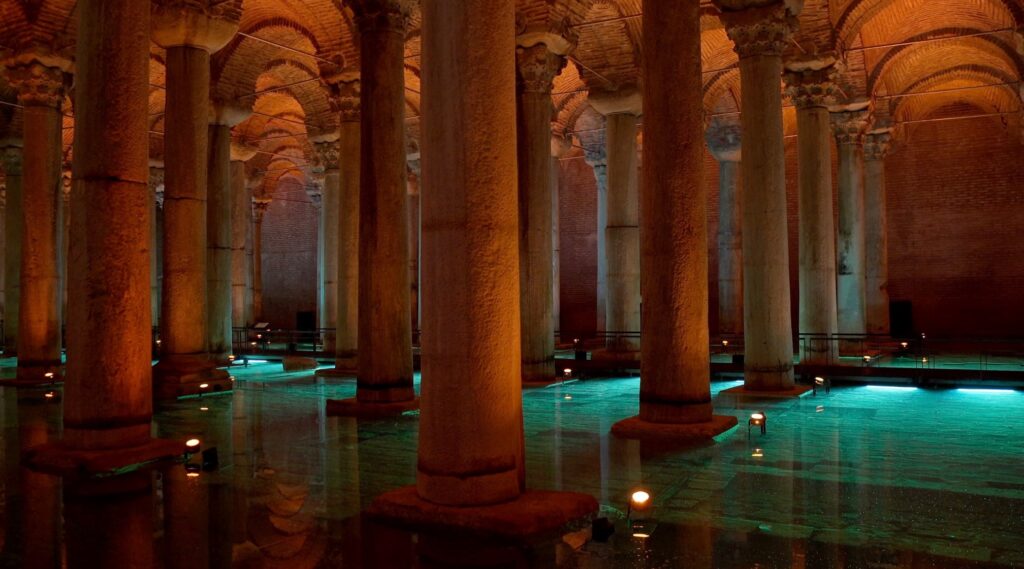
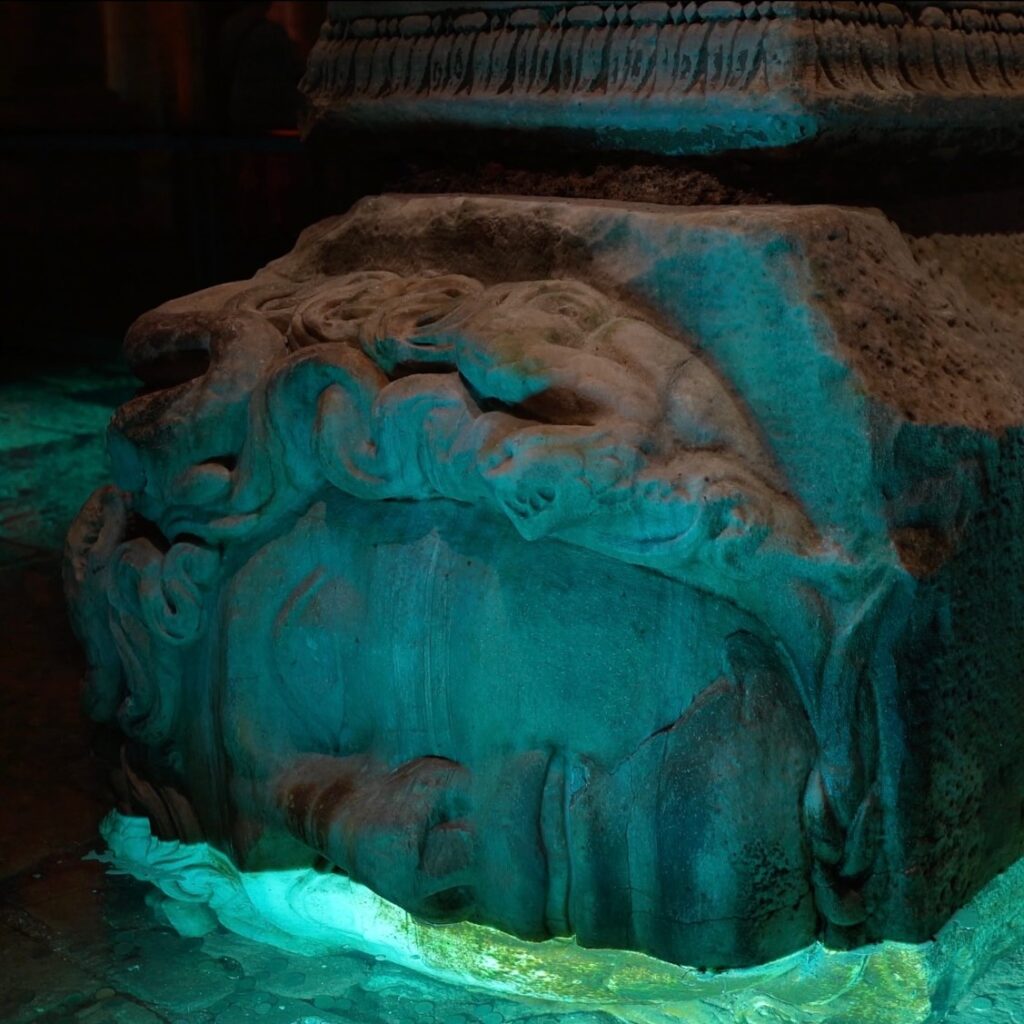
Built in the 6th century, the subterranean Basilica Cistern is another amazing piece of history and ingenuity. This is an ancient aqueduct that carried water from 12 miles away to be stored here in the cistern for the city’s elite to use. The 336 columns that support this underground cistern are actually recycled marble and granite columns from older buildings that were in the area at that time. Wow, it makes you wonder how old those buildings were! These columns include two massive blocks from the late Roman period, that are carved with the head of the Medusa. These blocks were placed upside down to negate the power of the Gorgon’s gaze, and are pretty amazing.
Once holding almost 3 million cubic feet of water, only a small amount is kept in the cistern today for aesthetic purposes. This place has been featured in quite a few movies and I can see why. It is enormous inside, and the color changing lights give it an other-worldly and mesmerizing feel. The closer I looked at the ancient support columns, the more impressed I became. Some of them are intricately carved with flowers or vines, or Ancient Greek writing. As its name suggests, the Basilica Cistern is grand in scale and definitely worth a visit.
Galata Tower
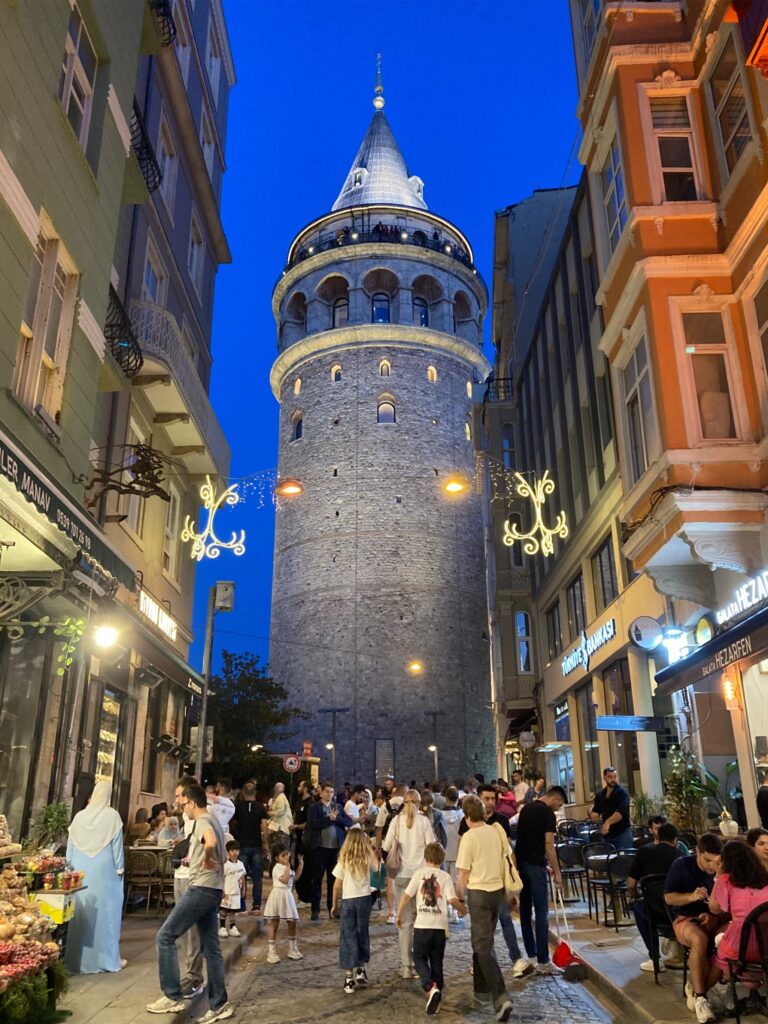
The Galata Tower is an old Genoese tower in the Galata section of the Beyoglu (Bay-oh-Lou) district. Just a few blocks walk from our hotel, the tower was built at the highest point of the ancient walls of Galata. It has been a watchtower for invaders, then used as a prison for over 200 years, and then as a lookout tower for fires. The tower is a historical symbol of this area, and it is really beautiful at night. It actually gets quite congested in the evenings and a little hectic. We walked up to it one evening and it was lovely. Then we went back early one morning to take pictures before all the tourists rolled in.
Galata Tower
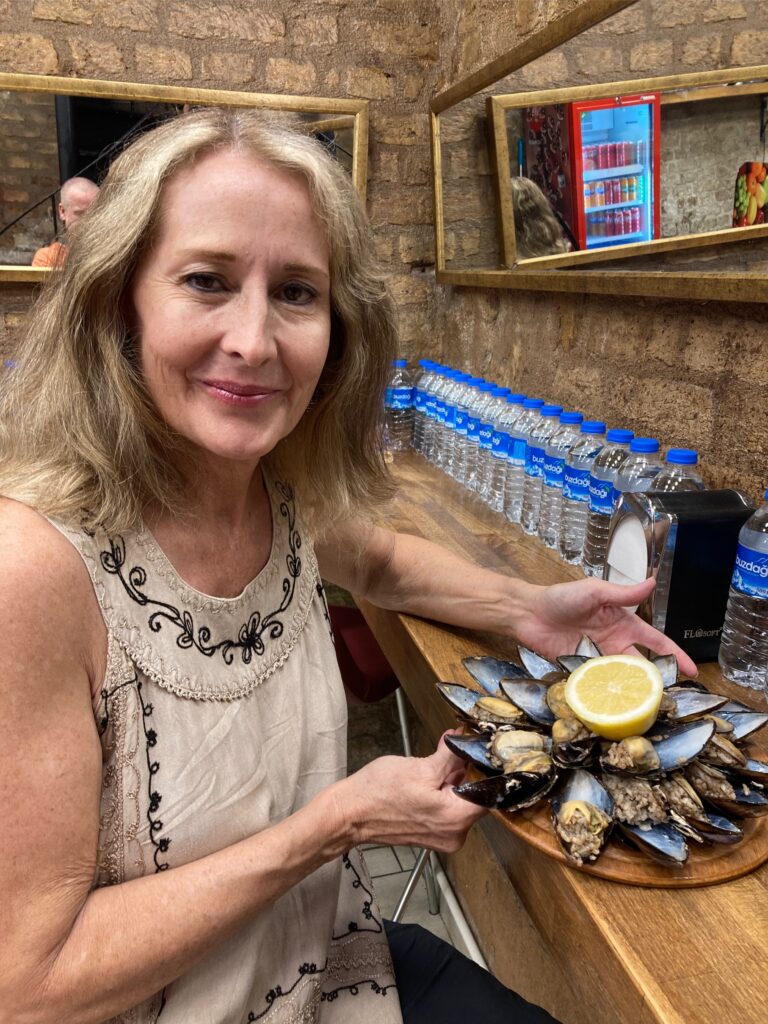
We opted to view it from the outside and skipped the $25.00 entrance fee and climb to the top. The tower is surrounded by some nice restaurants and a variety of shops. It was at one of these small restaurants that we first tried Midye Dolma.
Midye Dolma
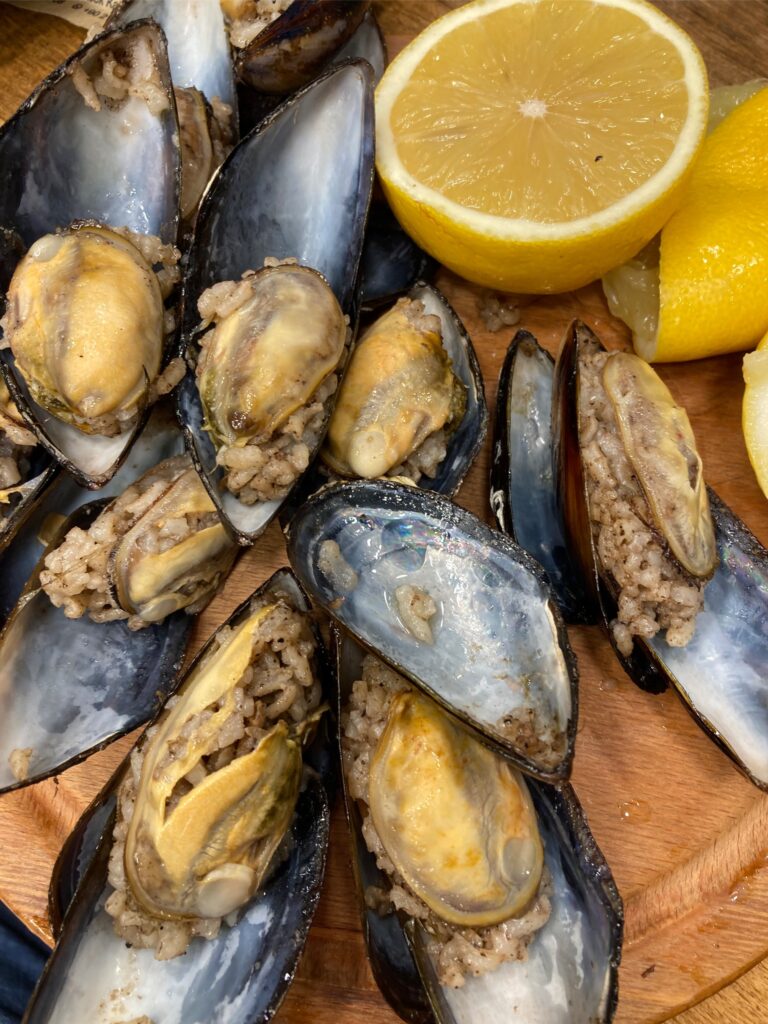
Popular as a street food and in restaurants, these are steamed mussels stuffed with aromatic rice. A squeeze of fresh lemon on the top and they truly delicious. My husband and I would polish off about 60 every time we went out for them.
Sulaymaniye Mosque
There are 3,000 mosques here in Istanbul and many of them are very impressive. We had visited a few already and one that absolutely deserves a mention is the Sulaymaniye Mosque. It is beautiful and spacious inside, covered with amazing tile work. The outside is surrounded by lovely lawns and gardens. This mosque is one of the best known sites in Istanbul and offers a commanding view of the Golden Horn. It is also one of the largest Ottoman era mosque in the city. It was built in 1550 by Suliman the Magnificent. I love that name. I love all these ancient rulers names here, they end with the magnificent, the great, the mighty, the supreme, Emperor, or Cesar. These guys let it be known what they were all about. You can also visit the cemetery where the mausoleums of Suliman the Magnificent and his wife Hurrem Sultan can be found. Her mausoleum is especially lovely inside, covered with the blue Iznik tiles. This site is also free to visit.
Sulaymaniye Mosque
Kadikoy
One morning we took one of the many ferries that cross the strait, to check out the Kadikoy neighborhood on the Asian side of the Bosphorus. Kadikoy was actually named one of the 50 “coolest” neighborhoods in the world, along with being the liberal cultural center of the Anatolian side of Istanbul. Even though this area is home to many bars, cafes, restaurants, and shops, it still has a more relaxing vibe than the European side does. This laid back area is famous for its fish and produce markets. Knowing that, we decided to just spend the whole day here and check it all out.
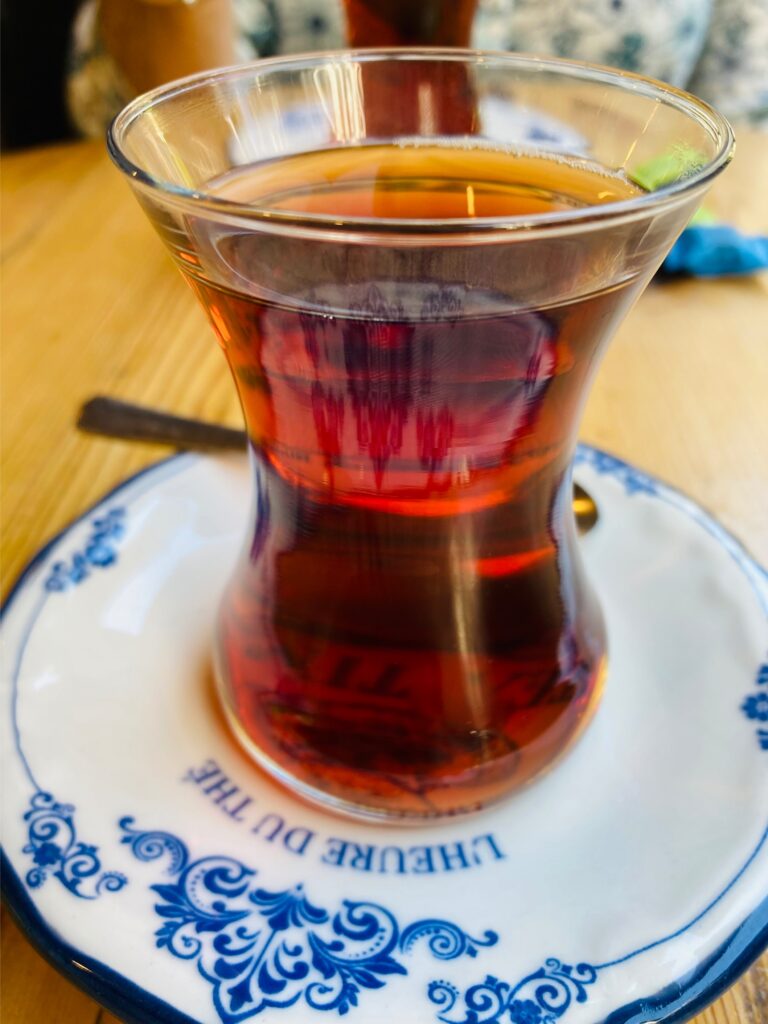
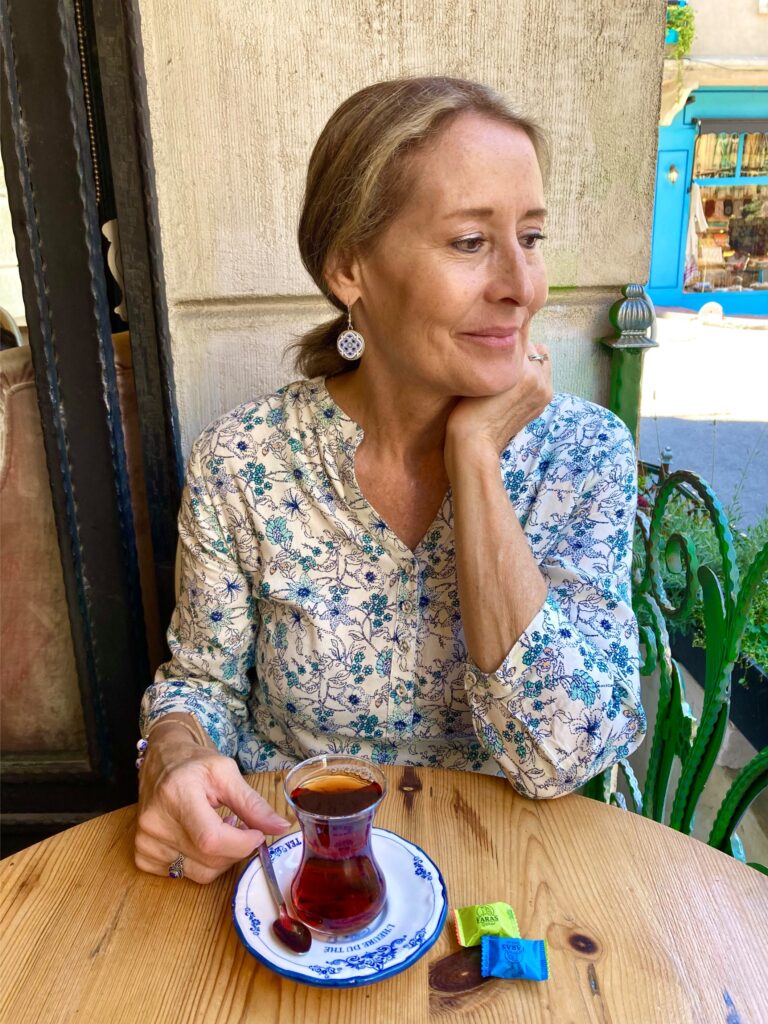
I loved wondering the streets here. The fresh fish and produce were amazing to look at, as was the neighborhood itself. After wondering around for an hour or so, we stopped at a corner bakery for some Baklava and Çay (Turkish tea). This was delightful. The shopping here was great as well. I ended up with a new outfit and some Nazar Boncugu, or the famous Blue Eye talismans, to take home for gifts. We had a wonderful seafood lunch at one of the restaurants adjacent to the fish market.
This is where I tried Raki for the first time. It’s popular to drink along with, and after meals here in Turkey. I liked Raki more than I thought I would. With its strong anise flavor, poured over ice and a touch of water, I actually fell in love with the refreshing taste.
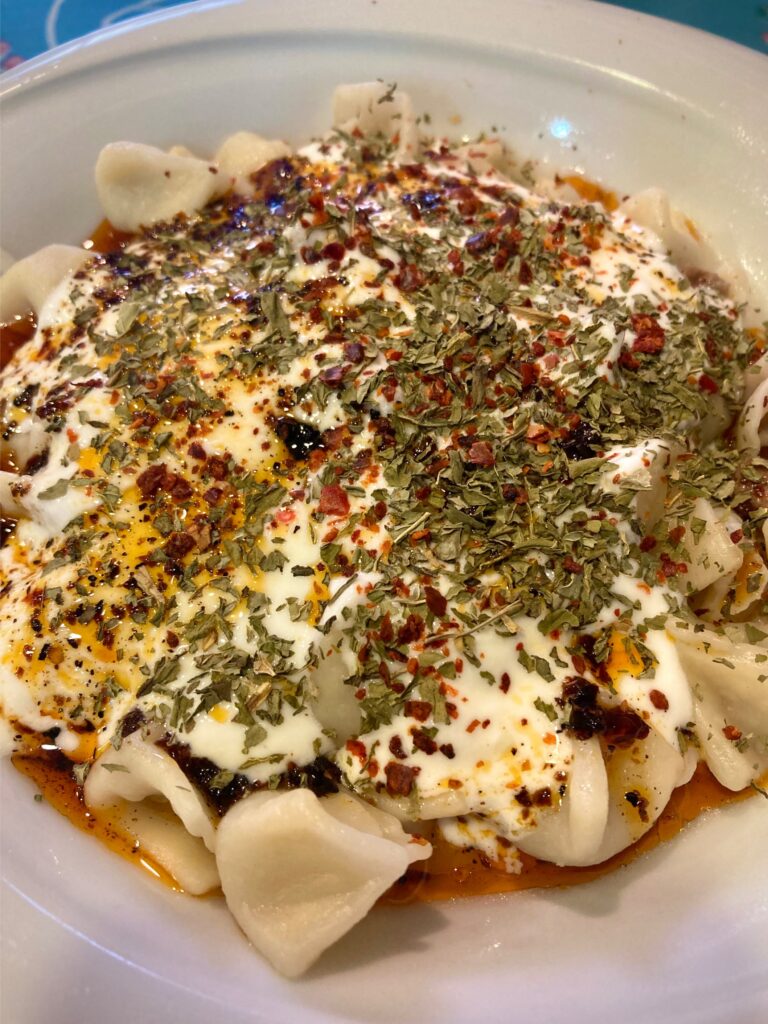
We ended up coming over here to spend another day during our time in Istanbul. During this trip we had a tasty lunch of Manti. This local dish features small ravioli like pouches stuffed with chunks of lamb. Topped with yogurt and either a garlic or a tomato sauce, it is amazing! I think I would like to stay here in the Kadikoy neighborhood on our next visit.
Manti
Topkapi Palace
One of the top sites in all of Istanbul, and one that really blew my mind, is the Topkapi Palace. Located in the old historic district of Fatih (Fought E). This palace served for 400 years as the administrative center for the Ottoman Empire and as a residence for the reigning sultan. Even after the court was moved to the new Dolmabahce Palace in 1857, Topkapi retained some of it’s functions serving as the imperial treasury, library, and mint.
At the end of the Ottoman Empire in 1923, the state turned Topkapi palace into a museum and library and is it ever grand. With over 400 rooms, covering 175 acres and surrounded by high walls, this place was so much more than what I was expecting. With majestic views, beautiful grounds and rose gardens, this sprawling palace made me feel like I was in a movie or had stepped into the past. From the lavish architecture and fountains, to the fine furnishings and Turkish carpets, this place was definitely made for Sultans. The enormous kitchens, which fed over 1,000 people a day, contain one of the world’s largest collections of Chinese blue and white and Celadon porcelain. These were favored by the sultans as it was believed that the color of the porcelain would change if the food contained poison.
Topkapi Dagger
The royal treasury was part museum, part fine jewelry display, and contains some of the finest treasures of the Ottoman age, including the famous bejeweled Topkapi Dagger, and the 83 karat Spoon Maker’s Diamond. I was overwhelmed by the stunning displays of not only jewelry, but gold and jewels that decorated everyday items the Sultan and his family used, such as hand held mirror, brushes, combs, and perfume bottles.
The royal treasury also contains the Harem. The Harem was home to the sultan’s mother, the Valide Sultan. She oversaw the 300 concubines and wives of the Sultan, and the rest of his family including his children, their servants, and eunuchs. She even chose the Sultan’s concubines and wives for him.
One thing the royal treasury held that I had no idea about, and was surprised by, was the Pavilion of the Holy Mantle where holy relics are kept. The Sultan was only allowed in this room once a year, on the 15th day of Ramadan. Now visitors pass through it daily. For me, this was the most fascinating areas of the palace and contains to many precious relics for me to go over here. But the beauty of this ancient palace and the history these walls hold should not be missed. It really conjures up the imagination. The entrance fee here is $46 USD and if you have to choose between the two palaces of Topkapi and Dolmabache, I personally would choose this one. We skipped Dolmabache Palace because being built in 1857 and having electricity and plumbing, it is considered modern. I know it is grand as well, so I will tour it on our next visit.
Gulhane Park
Gulhane Park sits on the grounds of the Topkapi Palace. This historical park is the oldest and one of the most expansive parks in all of Istanbul. Opened to the public in 1912, it is home to several of Istanbuls fantastic museums. You can definitely connect with nature here, right in the heart of the historic center. There are groups of small green parrots that nest in holes in the ancient castle walls that line one side of the park. They are a real treat to see out fluttering from tree to tree. And it is free to enter.
Simit
We stopped here to rest after touring the Topkapi Palace and got a Simit from the cart at the park entrance. Reminiscent of a large, thin bagel or soft pretzel, and covered with toasted sesame seeds, the Simit is a staple here in Istanbul. A tasty treat for about .30 cents!
Bosphorus Long Cruise
An essential part of any trip to Istanbul is traveling from one part on the city to another by ferry boat. There are also lots of short sightseeing cruises you can take, but nothing beats setting aside a whole day for the Bosphorus Long Cruise. It is very affordable, and you get to travel nearly the entire length of the strait from the sea of Marmara right up to the third bridge near the Black Sea. The entire trip takes around six and half hours. Leaving at 10:35 am and returning around 5:00 pm. The total cruising time is four hours roundtrip. The best part is you get two and half hours of free time as the boat docks at the quaint village of Anadolu Kavağı.
The ticket office is located at Eminonu Pier just to the east of the Galata Bridge. The ticket booth opens at 10:00 am and there is no need to buy tickets in advance as the boat has plenty of seating. There are three seating levels on the boat and include plenty of indoor (with AC) and outdoor seating, also restrooms and a snack bar. The views of Istanbul at the start of the trip are wonderful and you get a glimpse into the importance of the Bosphorus strait as an international trade route. You cruise past so many interesting and historic places like the Dolmabahce Palace and the Rumeli Fort. In spots you find yourself surrounded by beautiful neighborhoods clinging to the river banks and lining the hills. There are a few stops along the way to collect more passengers, and before you know it you get your first glimpse of the impressive Yavuz Sultan Selim Bridge and soon after, you dock at Anadolu Kavağı.
As soon as we disembarked from the boat we immediately followed the signs up to the Yoros Castle ruins. It was only about a 15 minute walk. The views from the hilltop are breathtaking and the castle ruins make for some nice pictures. It is a ruins, so you are free to just wander around at your own leisure. Originally settled by the Phoenicians and the Greeks in the BC era, many temple remains have been discovered all around this area.
After our short explorations we walked back down the hill and ended up at a great restaurant called Kavak Doğanay, which I highly recommend. It sits right on the water and I had some of the best Calamari I have ever eaten, and an amazing whole fish stewed in a tomato and pepper sauce. All to soon it was time to board the boat for our journey back. Please check out our Bosphorus Long Cruise video.
We spent a whole month in Istanbul discovering so many amazing places and so much delicious food. If you haven’t already, please check out our two Guides to Istanbul, YouTube videos that highlight what to see and do in this amazing city. I was truly impressed, and we do plan to return to Istanbul. On our next visit I would also like to see Troy, Ephesus, and do the whole Black Sea coast.
We have been slow traveling going on three years now and I sometimes I can hardly believe the amazing places and things we have seen. It makes us want to keep going, and our bucket list is just as long, or longer, than when we started.